
INFLUENCE OF THERMAL TREATMENT ON CRYSTALLINITY, DEFECT STATE,STABILITY, AND PHOTONIC CHARACTERISTICS OF ZnO NANOPARTICLES

Article Sidebar
-
ZnO Nanoparticles, Sol-gel, Calcination temperature, Crystallinity, Stability
Abstract
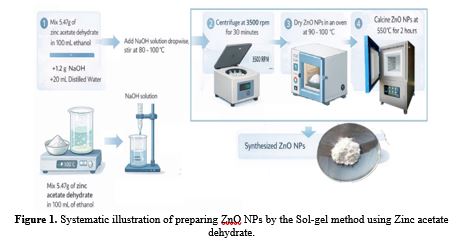
The sol-gel technique was successfully used to synthesize zinc oxide nanoparticles (ZnO NPs) from zinc acetate dehydrate as a reagent and sodium hydroxide as a medium to examine the influences of thermal treatment on the structural, morphological, and optical behaviour. Calcination was conducted at different temperatures ranging from 450°C to 750°C. The achieved zinc oxide nanoparticles were analyzed using various characterizations, including field emission scanning electron microscopy (FESEM), X-ray diffraction (XRD), UV-visible spectroscopy, and zeta potential analysis. The outcomes showed that calcination significantly affects crystallinity, particle size, bandgap, and stability. The ideal temperature emerged to be 550°C. X-ray diffraction validated the development of hexagonal wurtzite, demonstrating the highest crystallinity at 91.27%, the lowest crystallite size of 18.668 nm, the narrowest optical bandgap of 3.62 eV, and the best colloidal stability of -55.17 mV. These findings underscore the significance of heat control in tuning the properties of ZnO nanoparticles, rendering them appropriate for diverse applications in nanotechnology and optoelectronics.
Full text article
References
Ahmed, S., Saifullah, Ahmad, M., Swami, B. L., & Ikram, S. (2016). Green synthesis of silver nanoparticles using Azadirachta indica aqueous leaf extract. Journal of Radiation Research and Applied Sciences, 9(1), 1–7. DOI:https://doi.org/10.1016/j.jrras.2015.06.006
Alibe, I. M., Matori, A. K., Saion, E., Ali, A. M., & Zaid, M. H. M. (2017). The influence of calcination temperature on structural and optical properties of ZnO nanoparticles via simple polymer synthesis route. Science of Sintering, 49(3), 263–275. DOI:https://doi.org/10.2298/SOS1703263A
Altammar, K. A. (2023). A review on nanoparticles: characteristics, synthesis, applications, and challenges. Front Microbiol, 14, 1155622. DOI:https://doi.org/10.3389/fmicb.2023.1155622
Alzoubi, F., Ahmad, A. A., Aljarrah, I. A., Migdadi, A., & Al-Bataineh, Q. M. (2023). Localize surface plasmon resonance of silver nanoparticles using Mie theory. Journal of Materials Science: Materials in Electronics, 34(32), 2128. DOI:https://doi.org/10.1007/s10854-023-11304-x
Barzinjy, A. A., & Azeez, H. H. (2020). Green synthesis and characterization of zinc oxide nanoparticles using Eucalyptus globulus Labill. leaf extract and zinc nitrate hexahydrate salt. SN Applied Sciences, 2(5), 991. DOI:https://doi.org/10.1007/s42452-020-2813-1
Barzinjy, A. A., Hamad, S. M., Abdulrahman, A. F., Biro, S. J., & Ghafor, A. A. (2020). Biosynthesis, characterization and mechanism of formation of ZnO nanoparticles using Petroselinum crispum leaf extract. Current Organic Synthesis, 17(7), 558–566. DOI:https://doi.org/10.2174/1570179417666200628140547
Bekele, B., Jule, L., & Saka, A. (2021). The effects of annealing temperature on size, shape, structure and optical properties of synthesized zinc oxide nanoparticles by sol-gel methods. Digest Journal of Nanomaterials Biostructures, 16(2), 471–478. DOI:http://dx.doi.org/10.15251/DJNB.2021.162.471
Bian, S.-W., Mudunkotuwa, I., Rupasinghe, T., & Grassian, V. (2011). Aggregation and Dissolution of 4 nm ZnO Nanoparticles in Aqueous Environments: Influence of pH, Ionic Strength, Size, and Adsorption of Humic Acid. Langmuir : the ACS journal of surfaces and colloids, 27, 6059–6068. DOI:http://dx.doi.org/10.1021/la200570n
Bolhassani, A. (2023). Lipid-based delivery systems in development of genetic and subunit vaccines. Molecular Biotechnology, 65(5), 669 698. DOI:https://doi.org/10.1007/s12033-022-00624-8
Burg, D., & Ausubel, J. H. (2021). Moore’s Law revisited through Intel chip density. PloS one, 16(8), e0256245. DOI:https://doi.org/10.1371/journal.pone.0256245
Chang, J. S., Saint, C. P., Chow, C. W., Bahnemann, D. W., & Chong, M. N. (2024). Recent innovations in engineering Zinc Oxide (ZnO) nanostructures for water and wastewater treatment: Pushing the boundaries of multifunctional photocatalytic and advanced biotechnological applications. International Materials Reviews, 69(7–8), 337–379. DOI:https://doi.org/10.1177/09506608241280421
ElFaham, M. M., Mostafa, A. M., & Mwafy, E. A. (2021). The effect of reaction temperature on structural, optical and electrical properties of tunable ZnO nanoparticles synthesized by hydrothermal method. Journal of Physics and Chemistry of Solids, 154, 110089. DOI:https://doi.org/10.1016/j.jpcs.2021.110089
Fadaie, N., Sheikhi, M., Mohammadi, T., Tofighy, M. A., Rajabzadeh, S., & Sahebi, S. (2021). Novel Plasma Functionalized Graphene Nanoplatelets (GNPs) incorporated in forward osmosis substrate with improved performance and tensile strength. Journal of Environmental Chemical Engineering, 9(4), 105708. DOI:https://doi.org/10.1016/j.jece.2021.105708
Gopinath, S. C. (2020). Nanoparticles in Analytical and Medical Devices. Elsevier. DOI:https://doi.org/10.1016/B978-0-12-821163-
2.00001-7
Holzwarth, U., & Gibson, N. (2011). The Scherrer equation versus the’Debye-Scherrer equation’. Nature nanotechnology, 6(9),
534–534. DOI:https://doi.org/10.1038/nnano.2011.145
Ismail, A. M., Menazea, A., Kabary, H. A., El-Sherbiny, A., & Samy, A. (2019). The influence of calcination temperature on structural and antimicrobial characteristics of zinc oxide nanoparticles synthesized by Sol–Gel method. Journal of Molecular Structure, 1196, 332–337. DOI:https://doi.org/10.1016/j.molstruc.2019.06.084
Ismail, S. M., & Ahmed, S. M. (2023). The effect of calcination temperatures on the properties of ZnO nanoparticles synthesized by using leaves extracts of pinus brutia tree. Science Journal of University of Zakho, 11(2), 286–297. DOI:https://doi.org/10.25271/sjuoz.2023.11.2.1087
Kaur, A., Kaur, H., Singh, R., & Singh, V. K. (2025). Implications on Structural, Morphological, and Optical Properties and Photocatalytic Degradation Behavior of Zinc Oxide Nanoparticles: Effect of Calcination Temperature. JOM, 1–11. DOI:https://doi.org/10.1007/s11837-025-07344-9
Kayaci, F., Vempati, S., Donmez, I., Biyikli, N., & Uyar, T. (2014). Role of zinc interstitials and oxygen vacancies of ZnO in photocatalysis:
A bottom-up approach to control defect density. Nanoscale, 6. DOI:http://dx.doi.org/10.1039/c4nr01887g
Khan, S., & Hossain, M. K. (2022). Classification and properties of nanoparticles. Nanoparticle-based polymer composites, 15–54. DOI:https://doi.org/10.1016/B978-0-12-824272-8.00009-9
Kotousov, A., Khanna, A., & Bun, S. (2014). An analysis of elastoplastic fracture criteria. Recent Advances in Structural Integrity Analysis - Proceedings of the International Congress (APCF/SIF- 2014), 67–71. DOI:https://doi.org/10.1533/9780081002254.67
Kumar, S., Hussain, A., Siddiqui, A. M., Khan, Z. H., Abdullah, M. M., & Ashraf, M. T. (2024). Synthesis and study of the impact
of calcination duration on the properties of Al4 (ZnO) 96 nanoparticles. Nano-Structures and Nano-Objects, 39, 101250. DOI:https://doi.org/10.1016/j.nanoso.2024.101250
Loza, K., Epple, M., & Maskos, M. (2019). Stability of nanoparticle dispersions and particle agglomeration. Biological Responses
to Nanoscale Particles: MolecularCellular Aspects Methodological Approaches, 85–100. DOI:https://doi.org/10.1007/978-3-
030-12461-8_4
Mahajan, M., Kumar, S., Gaur, J., Kaushal, S., Dalal, J., Singh, G. & Ahlawat, D. S. (2025). Green synthesis of ZnO nanoparticles using Justicia adhatoda for photocatalytic degradation of malachite green and reduction of 4-nitrophenol. RSC advances, 15(4),
2958–2980. DOI:https://doi.org/10.1039/D4RA08632E
Mahato, S. S., Mahata, D., Panda, S., & Mahata, S. (2023). Perspective chapter: sol-gel science and technology in context of nanomaterials–recent advances. Sol-Gel Method-Recent Advances. DOI:https://doi.org/10.5772/intechopen.111378
Malik, S., Muhammad, K., & Waheed, Y. (2023). Nanotechnology: a revolution in modern industry. Molecules, 28(2), 661.
DOI:https://doi.org/10.3390/molecules28020661
Mohamed, A. F., & Mawlud, S. Q. (2023). Effect of zinc oxide on structural and optical properties borotellurite glass: ternary glass. Zanco Journal of Pure Applied Sciences, 35(4), 14–21. DOI:http://dx.doi.org/10.21271/ZJPAS.35.4.02
Nagar, V., Singh, T., Tiwari, Y., Aseri, V., Pandit, P. P., Chopade, R. L., & Awasthi, G. (2022). ZnO Nanoparticles: Exposure, toxicity
mechanism and assessment. Materials Today: Proceedings, 69, 56–63. DOI:https://doi.org/10.1016/j.matpr.2022.09.001
Nandhini, J., Karthikeyan, E., & Rajeshkumar, S. (2024). Green synthesis of zinc oxide nanoparticles: eco-friendly advancements
for biomedical marvels. Resources Chemicals and Materials. DOI:https://doi.org/10.1016/j.recm.2024.05.001
Onugwu, A. L., Nwagwu, C. S., Onugwu, O. S., Echezona, A. C., Agbo, C. P., Ihim, S. A., ..., & Khutoryanskiy, V. V. (2023). Nanotechnology
based drug delivery systems for the treatment of anterior segment eye diseases. Journal of Controlled Release, 354, 465–488. DOI:https://doi.org/10.1016/j.jconrel.2023.01.018
Owuna, F. J. (2020). Stability of vegetable based oils used in the formulation of ecofriendly lubricants – a review. Egyptian Journal of Petroleum, 29(3), 251–256. DOI:https://doi.org/10.1016/j.ejpe.2020.09.003
Pal Singh, R. P., Hudiara, I. S., & Bhushan Rana, S. (2016). Effect of calcination temperature on the structural, optical and magnetic properties of pure and Fe-doped ZnO nanoparticles. Materials Science-Poland, 34(2), 451–459. DOI:https://doi.org/10.1515msp-2016-0059
Parajuli, D., Dangi, S., Sharma, B. R., Shah, N. L., &
KC, D. (2023). Sol-gel synthesis, characterization of ZnO thin films on different substrates, and bandgap calculation
by the Tauc plot method. Bibechana, 20(2), 113–125. DOI:https://doi.org/10.3126/bibechana.v20i2.54115
Roy, A., Healey, C. P., Larm, N. E., Ishtaweera, P., Roca, M., & Baker, G. A. (2024). The huge role of tiny impurities in nanoscale synthesis. ACS Nanoscience Au, 4(3), 176–193. DOI:https://doi.org/10.1021/acsnanoscienceau.3c00056
Sa, Y., Guo, Y., Feng, X., Wang, M., Li, P., Gao, Y., & Jiang, T. (2017). Are different crystallinity-indexcalculating methods of hydroxyapatite efficient and consistent? New Journal of Chemistry, 41(13), 5723–5731. DOI:https://doi.org/10.1039/C7NJ00803A
Samantaray, S., Mallick, P., Hung, I.-M., Moniruzzaman, M., Satpathy, S. K., & Mohanty, D. (2024). Ceramicceramic nanocomposite materials for energy storage applications: A review. Journal of Energy Storage, 99, 113330. DOI:https://doi.org/10.1016/j.est.2024.113330
Shafiee, P., Nafchi, M. R., Eskandarinezhad, S., Mahmoudi, S., & Ahmadi, E. (2021). Sol-gel zinc oxide nanoparticles: advances in synthesis and applications. Synthesis Sintering, 1(4), 242–254. DOI:https://doi.org/10.53063/synsint.2021.1477
Sharma, R., Sharma, A., Chuhadiya, S., Thakur, A., Kannan, M., & Dhaka, M. (2023). Air annealing evolution to physical characteristics of Cd0. 85Zn0. 15Te thin films: absorber layer applications to solar cell devices. Journal of Materials Science: Materials in Electronics, 34(18), 1403. DOI:https://doi.org/10.1007/s10854-023-10759-2
Sharma, V., Sharma, J., Kansay, V., Sharma, V. D., Sharma, A., Kumar, S., ..., & Bera, M. (2023). The effect of calcination temperatures on the structural and optical properties of zinc oxide nanoparticles and their influence on the photocatalytic degradation of leather dye. Chemical Physics Impact, 6, 100196. DOI:https://doi.org/10.1016/j.chphi.2023.100196
Şimşek, T., Ceylan, A., Aşkın, G. Ş., & Özcan, Ş. (2022). Band gap engineering of ZnO nanocrystallites prepared via ball-milling. Politeknik Dergisi, 25(1), 89–94. DOI:https://doi.org/10.2339/politeknik.647702
Sridar, R., Ramanane, U. U., & Rajasimman, M. (2018). ZnO nanoparticles – Synthesis, characterization and its application for phenol removal from synthetic and pharmaceutical industry wastewater. Environmental Nanotechnology, Monitoring & Management, 10, 388–393. DOI:https://doi.org/10.1016/j.enmm.2018.09.003
Sugihartono, I., Retnoningtyas, A., Rustana, C., Umiatin, Yudasari, N., Isnaeni, ..., & Kurniadewi, F. (2019). The influence of calcination temperature on optical properties of ZnO nanoparticles. AIP Conference Proceedings.
Supin, K. K., PM, P. N., & Vasundhara, M. (2023). Enhanced photocatalytic activity in ZnO nanoparticles developed using novel Lepidagathis ananthapuramensis leaf extract. RSC advances, 13(3), 1497–1515. DOI:https://doi.org/10.1039/D2RA06967A
Tripathy, N., & Kim, D.-H. (2018). Metal oxide modified ZnO nanomaterials for biosensor applications. Nano convergence, 5(1), 27. DOI:https://doi.org/10.1186/s40580-018-0159-9
Usman, A., Aris, A., Labaran, B., Darwish, M., & Jagaba, A. (2022). Effect of calcination temperature on the morphology, crystallinity,
and photocatalytic activity of ZnO/TiO2 in selenite photoreduction from aqueous phase. J. New Mater. Electrochem. Syst., 25(4), 251–258. DOI:https://doi.org/10.14447/jnmes.v25i4.a05
Zubair, M. A., Mouri, T. K., & Chowdhury, M. T. (2023). Influence of Cu induced crystallographic disorder on the optical and lattice vibrational properties of ZnO nanoparticles. Physical Chemistry and Chemical Physics, 25(40), 27628–27653. DOI:https://doi.org/10.1039/D3CP02015K
Authors
Copyright (c) 2026 Mohammed M. Hamadali, and Muhamad A. Hamad

This work is licensed under a Creative Commons Attribution-NonCommercial-ShareAlike 4.0 International License.
Authors who publish with this journal agree to the following terms:
- Authors retain copyright and grant the journal right of first publication with the work simultaneously licensed under a Creative Commons Attribution License [CC BY-NC-SA 4.0] that allows others to share the work with an acknowledgment of the work's authorship and initial publication in this journal.
- Authors are able to enter into separate, additional contractual arrangements for the non-exclusive distribution of the journal's published version of the work, with an acknowledgment of its initial publication in this journal.
- Authors are permitted and encouraged to post their work online.