
ASSESSMENT OF BACTERIAL CONTAMINATION IN CHICKEN MEAT SHAWARMA INERBIL CITY AND ANTIBACTERIAL EFFECT OF ZnO–CHITOSAN NANOPARTICLES

Article Sidebar
-
Chicken meat shawarma, bacterial contamination, ZNO and Chitosan nanoparticles, Antimicrobial Activity, Food safety.
Abstract
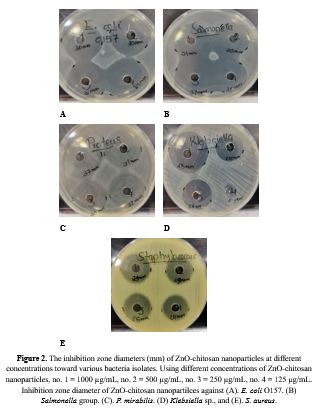
This study investigated the microbiological safety of chicken shawarma sold in Erbil, Kurdistan Region, Iraq, by considering its contamination level and studying the antibacterial action of ZnO-chitosan nanoparticles. Thirty chicken shawarma samples were collected and screened for bacterial contamination using standard microbiological methods. It was revealed that 70% of the samples had high total viable counts. Salmonella (26%), Escherichia coli O157 (16.6%), and some coliforms (10%), as well as Klebsiella (10%), Proteus (6.6%), and Staphylococcus aureus (6.6%) were also isolated, indicating that the sample had poor hygiene and the associated practices were unsafe. It was observed that ZnO-chitosan nanoparticles showed remarkable inhibition zones against all the bacteria tested, with the highest zones at 10 mg/mL. These results raise serious concerns about the public’s health concerning chicken shawarma and suggest that natural antimicrobial nanocomposites could be effective as preservatives for enhancing shelf life and food safety.
Full text article
References
Ahmed, A. M., B El-Hakem, N. A., & Ibrahim, G. A. (2015). Chemical and microbial assessment of beef and chicken shawarma sandwiches
in Ismailia governorate and its impact on consumer health. Egyptian Journal of Chemistry and Environmental Health, 1(1),
686–693. DOI:https://doi.org/10.21608/ejceh.2015.253804
Al-Naamani, L., Dobretsov, S., & Dutta, J. (2016). Chitosan-zinc oxide nanoparticle composite coating for active food packaging applications. Innovative Food Science & Emerging Technologies, 38, 231–237. DOI:https://doi.org/10.1016/j.ifset.2016.10.010
Al-Naamani, L., Dutta, J., & Dobretsov, S. (2018). Nanocomposite Zinc Oxide-Chitosan Coatings on Polyethylene Films for Extending Storage Life of Okra (Abelmoschus esculentus). Nanomaterials (Basel), 8(7). DOI:https://doi.org/10.3390/nano8070479
Al-Nabulsi, A., Osaili, T., Sawalha, A., Olaimat, A. N., Albiss, B. A., Mehyar, G., Ayyash, M., & Holley, R. (2020). Antimicrobial activity of chitosan coating containing ZnO nanoparticles against E. coli O157: H7 on the surface of white brined cheese. International Journal of Food Microbiology, 334, 108838. DOI:https://doi.org/10.1016/j.ijfoodmicro.2020.108838
Alhujaily, M., Albukhaty, S., Yusuf, M., Mohammed, M. K. A., Sulaiman, G. M., Al-Karagoly, H., Alyamani, A. A., Albaqami, J., & Almalki, F. A. (2022). Recent Advances in Plant-Mediated Zinc Oxide Nanoparticles with Their Significant Biomedical Properties. Bioengineering (Basel), 9(10), 541. DOI:https://doi.org/10.3390/bioengineering9100541
Ali, S. A., Ali, E. S., Hamdy, G., Badawy, M., Ismail, A. R., El- Sabbagh, I. A., El-Fass, M. M., & Elsawy, M. A. (2024). Enhancing physical characteristics and antibacterial efficacy of chitosan through investigation of microwave-assisted chemically formulated chitosan-coated ZnO and chitosan/ZnO physical composite. Sci Rep, 14(1), 9348. DOI:https://doi.org/10.1038/s41598-024-
58862-6
Anugrah, D. S. B., Alexander, H., Pramitasari, R., Hudiyanti, D., & Sagita, C. P. (2020). A Review of Polysaccharide-Zinc Oxide Nanocomposites as Safe Coating for Fruits Preservation. Coatings, 10(10), 988. DOI:https://doi.org/10.3390/coatings10100988
Ayaz, M., Othman, F. A., Bahareth, T. O., Al-Sogair, A. M., & Sawaya, W. N. (1985). Microbiological Quality of Shawarma in Saudi Arabia. J Food Prot, 48(9), 811–814. DOI:https://doi.org/10.4315/0362-028X-48.9.811
Babaei-Ghazvini, A., Acharya, B., & Korber, D. R. (2021). Antimicrobial Biodegradable Food Packaging Based on Chitosan and Metal/Metal-Oxide Bio- Nanocomposites: A Review. Polymers (Basel), 13(16), 2790. DOI:https://doi.org/10.3390/polym13162790
Bhaskaran, N. A., Jitta, S. R., Salwa, Kumar, L., Sharma, P., Kulkarni, O. P., Hari, G., Gourishetti, K., Verma, R., Birangal, S. R., & Bhaskar, K. V. (2023). Folic acid-chitosan functionalized polymeric nanocarriers to treat colon cancer. Int J Biol Macromol, 253(Pt 5), 127142. DOI:https://doi.org/10.1016/j.ijbiomac.2023.127142
Carrasco, E., Morales-Rueda, A., & García-Gimeno, R. M. (2012). Cross-contamination and recontamination by Salmonella in foods: A review. Food Research International, 45(2), 545–556. DOI:https://doi.org/10.1016/j.foodres.2011.11.004
Dhillon, G. S., Kaur, S., & Brar, S. K. (2014). Facile fabrication and characterization of chitosan-based zinc oxide nanoparticles and evaluation of their antimicrobial and antibiofilm activity. International Nano Letters, 4(2), 107. DOI:https://doi.org/10.1007/s40089-014-0107-6
Dong, W., Su, J., Chen, Y., Xu, D., Cheng, L., Mao, L., Gao, Y., & Yuan, F. (2022). Characterization and antioxidant properties of chitosan film incorporated with modified silica nanoparticles as an active food packaging. Food Chem, 373(Pt A), 131414. DOI:https://doi.org/10.1016/j.foodchem.2021.131414
Eglezos, S., Huang, B., Dykes, G. A., & Fegan, N. (2010). The prevalence and concentration of Bacillus cereus in retail food products in Brisbane, Australia. Foodborne Pathog Dis, 7(7), 867–870. DOI:https://doi.org/10.1089/fpd.2009.0469
Ehsanur Rahman, S. M., Islam, S., Pan, J., Kong, D., Xi, Q., Du, Q., Yang, Y., Wang, J., Oh, D.-H., & Han, R. (2023). Marination ingredients on meat quality and safety—A review. Food Quality and Safety, 7, fyad027. DOI:https://doi.org/10.1093/fqsafe/fyad027
Gao, Y., & Wu, Y. (2022). Recent advances of chitosanbased nanoparticles for biomedical and biotechnological applications. Int J Biol Macromol, 203, 379–388. DOI:https://doi.org/10.1016/j.ijbiomac.2022.01.162
Haldorai, Y., & Shim, J.-J. (2013). Chitosan-zinc oxide hybrid composite for enhanced dye degradation and antibacterial activity. Composite Interfaces, 20(5), 365–377. DOI:https://doi.org/10.1080/15685543.2013.806124
Hamodi, M. I., & Younis, M. K. (2023). Preparation, characterization and releasing-swelling kinetics of myrrh based hydrogel. Science Journal of University of Zakho, 11(2), 139–152. DOI:https://doi.org/10.25271/sjuoz.2023.11.2.1147
Ibrahim, M. M. (2024). Identification of Salmonella typhimurium and Salmonella enteritidis in the imported frozen poultry.
Science Journal of University of Zakho, 12(2), 149–152. DOI:https://doi.org/10.25271/sjuoz.2024.12.2.1260
Issa, F. A. (2024). Antibiotic resistance patterns of common uropathogens isolated from females at Zakho city, Kurdistan region,
Iraq. Science Journal of University of Zakho, 12(4), 490–496. DOI:https://doi.org/10.25271/sjuoz.2024.12.4.1395
Kong, M., Chen, X. G., Xing, K., & Park, H. J. (2010). Antimicrobial properties of chitosan and mode of action: a state
of the article review. International Journal of Food Microbiolgy, 144(1), 51–63. DOI:https://doi.org/10.1016/j.ijfoodmicro.2010.09.012
Kudaer, N. B., Risan, M. H., Yousif, E., Kadhom, M., Raheem, R., & Salman, I. (2022). Effect of Zinc Oxide Nanoparticles on Capsular Gene Expression in Klebsiella pneumoniae Isolated from Clinical Samples. Biomimetics (Basel), 7(4), 180. DOI:https://doi.org/10.3390/biomimetics7040180
Kumar, S., Mukherjee, A., & Dutta, J. (2020). Chitosan based nanocomposite films and coatings: Emerging antimicrobial food
packaging alternatives. Trends in Food Science & Technology, 97, 196–209. DOI:https://doi.org/10.1016/j.tifs.2020.01.002
Li, L.-H., Deng, J.-C., Deng, H.-R., Liu, Z.-L., & Li, X.-L. (2010). Preparation, characterization and antimicrobial activities of chitosan/Ag/ZnO blend films. Chemical Engineering Journal, 160(1), 378–382. DOI:https://doi.org/10.1016/j.cej.2010.03.051
Malak, N., & Soliman, N. (2021). The effect of time and temperature variations on the microbial load and deterioration criteria of leftover cheeseburger sandwiches. Adv. Anim. Vet. Sci, 9(11), 1925–1932. DOI:https://doi.org/10.17582/journal.aavs/2021/9.11.1925.1932
Mohamed, E. F., & El-Zahaby, D. (2024). Detection of Bacteria Secreting Toxins in Shawarma and Their Sensitivity to Antibiotics
Using VITEK. Egyptian Journal of Veterinary Sciences, 1–10. DOI:https://doi.org/10.21608/ejvs.2024.292660.2120
Mohammed, L. Y. (2023). Antioxidant Activity and Physico-Chemical Properties of Green Synthesized Zinc Oxide Nanoparticles Using Eruca sativa Leaf Extract. Science Journal of University of Zakho, 11(4), 581–591. DOI:https://doi.org/10.25271/sjuoz.2023.11.4.1173
Munoz-Tebar, N., Perez-Alvarez, J. A., Fernandez-Lopez, J. & Viuda-Martos, M. (2023). Chitosan Edible Films and Coatings with Added Bioactive Compounds: Antibacterial and Antioxidant Properties and Their Application to Food Products: A Review. Polymers (Basel), 15(2), 396. DOI:https://doi.org/10.3390/polym15020396
Murali, M., Gowtham, H. G., Shilpa, N., Singh, S. B., Aiyaz, M., Sayyed, R. Z., Shivamallu, C., Achar, R. R., Silina, E., Stupin, V., Manturova, N., Shati, A. A., Alfaifi, M. Y., Elbehairi, S. E. I., & Kollur, S. P. (2023). Zinc oxide nanoparticles prepared through microbial mediated synthesis for therapeutic applications: a possible alternative for plants. Front Microbiol, 14, 1227951. DOI:https://doi.org/10.3389/fmicb.2023.1227951
Nimer, N. A., Al-Saa’da, R. J., & Abuelaish, O. (2016). Accuracy of the VITEK(R) 2 system for a rapid and direct identification and susceptibility testing of Gram-negative rods and Gram-positive cocci in blood samples. East Mediterr Health J, 22(3), 193–200.
DOI:https://doi.org/10.26719/2016.22.3.193
Nimri, L., Abu Al-Dahab, F., & Batchoun, R. (2014). Foodborne bacterial pathogens recovered from contaminated shawarma meat in northern Jordan. J Infect Dev Ctries, 8(11), 1407–1414. DOI:https://doi.org/10.3855/jidc.4368
Novikov, V. Y., Derkach, S. R., Konovalova, I. N., Dolgopyatova, N. V., & Kuchina, Y. A. (2023). Mechanism of Heterogeneous Alkaline Deacetylation of Chitin: A Review. Polymers (Basel), 15(7). DOI:https://doi.org/10.3390/polym15071729
Rawson, T. M., Wilson, R. C., O’hare, D., Herrero, P., Kambugu, A., Lamorde, M., Ellington, M., Georgiou, P., Cass, A., Hope, W. W., & Holmes, A. H. (2021). Optimizing antimicrobial use: challenges, advances and opportunities. Nat Rev Microbiol, 19(12), 747–758. DOI:https:/ doi.org/10.1038/s41579-021-00578-9
Reddy, K. M., Feris, K., Bell, J., Wingett, D. G., Hanley, C., & Punnoose, A. (2007). Selective toxicity of zinc oxide nanoparticles to prokaryotic and eukaryotic systems. Appl Phys Lett, 90(213902), 2139021–2139023. DOI:https://doi.org/10.1063/1.2742324
Saeed, W. Q., & Mohammad, I. M. (2021). Comparison between Chicken and Red Meat Shawarma Food for Bacterial Contamination. Journal of Duhok University, 24(2), 39–48. DOI:https://doi.org/10.26682/ajuod.2021.24.2.5
Sasidharan, S., Tey, L.-H., Djearamane, S., Ab Rashid, N. K. M., Pa, R., Rajendran, V., Syed, A., Wong, L. S., Santhanakrishnan,
V. K., & Asirvadam, V. S. (2024). Innovative use of chitosan/ ZnO NPs bio-nanocomposites for sustainable antimicrobial food packaging of poultry meat. Food Packaging and Shelf Life, 43, 101298. DOI:https://doi.org/10.1016/j.fpsl.2024.101298
Scolari, I. R., Paez, P. L., & Granero, G. E. (2024). Synergistic bactericidal combinations between gentamicin and chitosan capped ZnO nanoparticles: A promising strategy for repositioning this first-line antibiotic. Heliyon, 10(3), e25604. DOI:https://doi.org/10.1016 j.heliyon.2024.e25604
Shakir, N. A., Aslam, M., Bibi, T., & Rashid, N. (2021). ADP-dependent glucose/glucosamine kinase from Thermococcus kodakarensis: cloning and characterization. Int J Biol Macromol, 173, 168–179. DOI:https://doi.org/10.1016/j.ijbiomac.2021.01.019
Shi, L. E., Li, Z. H., Zheng, W., Zhao, Y. F., Jin, Y. F., & Tang, Z. X. (2014). Synthesis, antibacterial activity, antibacterial mechanism
and food applications of ZnO nanoparticles: a review. Food Addit Contam Part A Chem Anal Control Expo Risk Assess, 31(2), 173–186. DOI:https://doi.org/10.1080/19440049.2013.865147
Terpstra, M. J., Steenbekkers, L. P. A., De Maertelaere, N. C. M., & Nijhuis, S. (2005). Food storage and disposal: consumer practices
and knowledge. British Food Journal, 107(7), 526–533. DOI:https://doi.org/10.1108/00070700510606918
Viana, G. G. F., Cardozo, M. V., Pereira, J. G., & Rossi, G. a. M. (2025). Antimicrobial Resistant Staphylococcus spp., Escherichia coli, and Salmonella spp. in Food Handlers: A Global Review of Persistence, Transmission, and Mitigation Challenges. Pathogens, 14(5), 496. DOI:https://doi.org/10.3390/pathogens14050496
Authors
Copyright (c) 2026 Zhelan Abdulrahman Ahmed, and Khalid Ismail Aziz

This work is licensed under a Creative Commons Attribution-NonCommercial-ShareAlike 4.0 International License.
Authors who publish with this journal agree to the following terms:
- Authors retain copyright and grant the journal right of first publication with the work simultaneously licensed under a Creative Commons Attribution License [CC BY-NC-SA 4.0] that allows others to share the work with an acknowledgment of the work's authorship and initial publication in this journal.
- Authors are able to enter into separate, additional contractual arrangements for the non-exclusive distribution of the journal's published version of the work, with an acknowledgment of its initial publication in this journal.
- Authors are permitted and encouraged to post their work online.