
DEEP LEARNING-BASED SKIN DISEASE DETECTION AND CLASSIFICATION

Article Sidebar
-
CNN, Deep Learning, Skin Disease, ConvNeXt-Tiny, , Hybrid Augmentation, Dermoscopy
Abstract
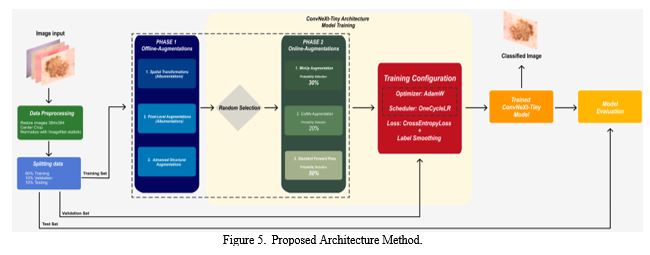
Automatic classification of dermoscopy images is essential for the early diagnosis and treatment of skin diseases. However, this task is challenging due to visual similarities between disease types, variations in skin structures, and differences across disease stages. To address these difficulties, Deep Learning (DL) has emerged as a powerful approach for computer-aided dermatological diagnosis. In this study, we propose a DL framework specifically designed for skin disease classification. The model employs a lightweight ConvNeXt-Tiny architecture, combined with a two-phase hybrid data augmentation strategy and an advanced optimization pipeline. The methodology includes extensive preprocessing of dermoscopic images, followed by hybrid augmentation that merges offline transformations (spatial, pixel-level, structural) with online probabilistic methods such as MixUp and CutMix. This approach improves minority class representation and stabilizes decision boundaries. Experiments on the HAM10000 dataset show strong results: 95.21% accuracy, 93.89% precision, 89.87% recall, 98.62% specificity, 91.60% F1-score, and 98.98% AUC. These outcomes surpass baseline ConvNeXt variants and other state-of-the-art methods. The proposed framework offers a practical solution for deployment in resource-constrained clinical environments, supporting accurate and early diagnosis of skin diseases
Full text article
References
Aboulmira, A., Hrimech, H., & Lachgar, M. (2024). Skin Diseases Classification with Machine Learning and Deep Learning Techniques: A Systematic Review. International Journal of Advanced Computer Science and Applications, 15(10), 1155–1173. https://doi.org/10.14569/IJACSA.2024.01510118
Ahmad, N., Shah, J. H., Khan, M. A., Baili, J., Ansari, G. J., Tariq, U., Kim, Y. J., & Cha, J. H. (2023). A novel framework of multiclass skin lesion recognition from dermoscopic images using deep learning and explainable AI. Frontiers in Oncology, 13(June), 1–17. https://doi.org/10.3389/fonc.2023.1151257
Alam, T. M., Shaukat, K., Khan, W. A., Hameed, I. A., Almuqren, L. A., Raza, M. A., Aslam, M., & Luo, S. (2022). An Efficient Deep Learning-Based Skin Cancer Classifier for an Imbalanced Dataset. Diagnostics, 12(9). https://doi.org/10.3390/diagnostics12092115
Ali, K., Shaikh, Z. A., Khan, A. A., & Laghari, A. A. (2022). Multiclass skin cancer classification using EfficientNets – a first step towards preventing skin cancer. Neuroscience Informatics, 2(4), 100034. https://doi.org/10.1016/j.neuri.2021.100034
Almutairi, A., & Khan, R. U. (2023). Image-Based Classical Features and Machine Learning Analysis of Skin Cancer Instances. Applied Sciences (Switzerland), 13(13). https://doi.org/10.3390/app13137712
Alotaibi, A., & AlSaeed, D. (2025). Skin Cancer Detection Using Transfer Learning and Deep Attention Mechanisms. Diagnostics, 15(1). https://doi.org/10.3390/diagnostics15010099
Anand, V., Gupta, S., Altameem, A., Nayak, S. R., Poonia, R. C., Khader, A., & Saudagar, J. (2022). An Enhanced Transfer Learning Based Classification for Diagnosis of Skin Cancer.
Angurana, N., Rajan, A. P., & Srivastava, I. (2019). Skin Cancer Detection and Classification. International Journal of Engineering and Management Research, 9(2), 111–114. https://doi.org/10.31033/ijemr.9.2.13
Aruk, I., Pacal, I., & Toprak, A. N. (2025). A novel hybrid ConvNeXt-based approach for enhanced skin lesion classification. Expert Systems with Applications, 283(February), 127721. https://doi.org/10.1016/j.eswa.2025.127721
Behara, K., Bhero, E., & Agee, J. T. (2023). Skin Lesion Synthesis and Classification Using an Improved DCGAN Classifier. Diagnostics, 13(16). https://doi.org/10.3390/diagnostics13162635
El-fattah, I. A., Ali, A. M., El-shafai, W., Taha, T. E., & El-samie, F. E. A. (2023). Deep-learning-based super-resolution and classification framework for skin disease detection applications. Optical and Quantum Electronics, March. https://doi.org/10.1007/s11082-022-04432-x
Gururaj, H. L., Manju, N., Nagarjun, A., Manjunath Aradhya, V. N., & Flammini, F. (2023). DeepSkin: A Deep Learning Approach for Skin Cancer Classification. IEEE Access, 11(April), 50205–50214. https://doi.org/10.1109/ACCESS.2023.3274848
Hao, S., Zhang, L., Jiang, Y., Wang, J., Ji, Z., Zhao, L., & Ganchev, I. (2023). ConvNeXt-ST-AFF: A Novel Skin Disease Classification Model Based on Fusion of ConvNeXt and Swin Transformer. IEEE Access, 11(September), 117460–117473. https://doi.org/10.1109/ACCESS.2023.3324042
Hosny, K. M., Said, W., Elmezain, M., & Kassem, M. A. (2024). Explainable deep inherent learning for multi-classes skin lesion classification. Applied Soft Computing, 159(November 2023), 111624. https://doi.org/10.1016/j.asoc.2024.111624
Hu, Z., Mei, W., Chen, H., & Hou, W. (2024). Multi-scale feature fusion and class weight loss for skin lesion classification. Computers in Biology and Medicine, 176(May), 108594. https://doi.org/10.1016/j.compbiomed.2024.108594
Jain, S., Singhania, U., Tripathy, B., Nasr, E. A., & Aboudaif, M. K. (2021). Deep Learning-Based Transfer Learning for Classification of Skin Cancer. Sensors, 21(8142), 16. https://doi.org/https://doi.org/10.3390/s21238142
Ji, Z., Wang, X., Liu, C., Wang, Z., Yuan, N., & Ganchev, I. (2024). EFAM-Net: A Multi-Class Skin Lesion Classification Model Utilizing Enhanced Feature Fusion and Attention Mechanisms. IEEE Access, September, 143029–143041. https://doi.org/10.1109/ACCESS.2024.3468612
Kalaiarasan, R., Madhan Kumar, K., Sridhar, S., & Yuvarai, M. (2022). Deep Learning-based Transfer Learning for Classification of Skin Cancer. Proceedings - International Conference on Applied Artificial Intelligence and Computing, ICAAIC 2022, 450–454. https://doi.org/10.1109/ICAAIC53929.2022.9792651
Karthik, R., Vaichole, T. S., Kulkarni, S. K., Yadav, O., & Khan, F. (2022). Eff2Net: An efficient channel attention-based convolutional neural network for skin disease classification. Biomedical Signal Processing and Control, 73(October 2021), 103406. https://doi.org/10.1016/j.bspc.2021.103406
Kavitha, C., Priyanka, S., Kumar, M. P., & Kusuma, V. (2024). Skin Cancer Detection and Classification using Deep Learning Techniques. Procedia Computer Science, 235(2023), 2793–2802. https://doi.org/10.1016/j.procs.2024.04.264
Li, Z., Koban, K. C., Schenck, T. L., Giunta, R. E., Li, Q., & Sun, Y. (2022). Artificial Intelligence in Dermatology Image Analysis: Current Developments and Future Trends. Journal of Clinical Medicine, 11(22). https://doi.org/10.3390/jcm11226826
Lilhore, U. K., Sharma, Y. K., Simaiya, S., Alroobaea, R., Baqasah, A. M., Alsafyani, M., & Alhazmi, A. (2025). SkinEHDLF a hybrid deep learning approach for accurate skin cancer classification in complex systems. Scientific Reports, 15(1), 1–32. https://doi.org/10.1038/s41598-025-98205-7
Liu, Wang, X., Liu, H., Zang, X., Li, L., Ji, Z., & Ganchev, I. (2025). FUSCANet: Enhancing Skin Disease Classification through Feature Fusion and Spatial-Channel Attention Mechanisms. IEEE Access, 13(June), 100683–100698. https://doi.org/10.1109/ACCESS.2025.3577740
Liu, Z., Mao, H., Wu, C.-Y., Feichtenhofer, C., Darrell, T., & Xie, S. (2022). A ConvNet for the 2020s. 2022 IEEE/CVF Conference on Computer Vision and Pattern Recognition (CVPR), 11966–11976. https://doi.org/10.1109/CVPR52688.2022.01167
Malik, S. G., Jamil, S. S., Aziz, A., Ullah, S., Ullah, I., & Abohashrh, M. (2024). High-Precision Skin Disease Diagnosis through Deep Learning on Dermoscopic Images. Bioengineering, 11(9), 867. https://doi.org/10.3390/bioengineering11090867
Niino, M., & Matsuda, T. (2021). Age-specific skin cancer incidence rate in the world. Japanese Journal of Clinical Oncology, 51(5), 848–849. https://doi.org/10.1093/jjco/hyab057
Shahzad, K., Wasim, M., Pires, I. M., & Garcia, N. M. (2024). Multi- classification of skin lesions using a deep learning-based convolutional neural network. Procedia Computer Science, 241(2019), 588–593. https://doi.org/10.1016/j.procs.2024.08.085
Su, Q., Hamed, H. N. A., Isa, M. A., Hao, X., & Dai, X. (2024). A GAN-Based Data Augmentation Method for Imbalanced Multi-Class Skin Lesion Classification. IEEE Access, 12(January), 16498–16513. https://doi.org/10.1109/ACCESS.2024.3360215
Tschandl, P. (2021). Artificial intelligence for melanoma diagnosis. Italian Journal of Dermatology and Venereology, 156(3), 289–299. https://doi.org/10.23736/S2784-8671.20.06753-X
Tschandl, P., Rosendahl, C., & Kittler, H. (2018). Data descriptor: The HAM10000 dataset, a large collection of multi-source dermatoscopic images of common pigmented skin lesions. Scientific Data, 5, 1–10. https://doi.org/10.1038/sdata.2018.161
Wei, M., Wu, Q., Ji, H., Wang, J., Lyu, T., Liu, J., & Zhao, L. (2023). A Skin Disease Classification Model Based on DenseNet and ConvNeXt Fusion. Electronics (Switzerland), 12(2), 1–19. https://doi.org/10.3390/electronics12020438
Xin, C., Liu, Z., Zhao, K., Miao, L., Ma, Y., Zhu, X., Zhou, Q., Wang, S., Li, L., Yang, F., Xu, S., & Chen, H. (2022). An improved transformer network for skin cancer classification. Computers in Biology and Medicine, 149(June), 105939. https://doi.org/10.1016/j.compbiomed.2022.105939
Authors
Copyright (c) 2026 Zhehat Rebar Abdulqader, and Araz Rajab Abrahim

This work is licensed under a Creative Commons Attribution-NonCommercial-ShareAlike 4.0 International License.
Authors who publish with this journal agree to the following terms:
- Authors retain copyright and grant the journal right of first publication with the work simultaneously licensed under a Creative Commons Attribution License [CC BY-NC-SA 4.0] that allows others to share the work with an acknowledgment of the work's authorship and initial publication in this journal.
- Authors are able to enter into separate, additional contractual arrangements for the non-exclusive distribution of the journal's published version of the work, with an acknowledgment of its initial publication in this journal.
- Authors are permitted and encouraged to post their work online.