
BIOSYNTHESIS AND CHARACTERIZATION OF NiO THIN FILM USING LEAF EXTRACTION OF LEEK PLANT BY USING THE SPRAY PYROLYSIS TECHNIQUE

Article Sidebar
-
Green synthesis, Modified Spray pyrolysis, NiO NPs, growth process
Abstract
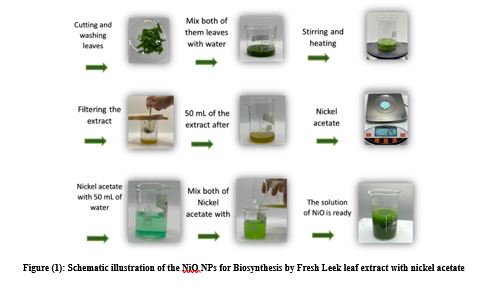
Nickel oxide (NiO) nanoparticles were successfully synthesized by a green and affordable method, and an aqueous extract of Fresh Leek leaf was employed as a bio-reducing and capping agent. The synthesis was accomplished in two-steps: the seed layer on glass substrate was deposited by a slightly modified spray pyrolysis method employing nickel acetate precursor and undergoing spin coating technique; one followed by the growth of nanoparticles from a solution of nickel nitrate at different pH (9, 10 and 11). The elemental, structural, morphological and optical properties of the biosynthesized NiO NPs were fully determined. Field emission scanning electron microscopy (FESEM) showed that the spherical nanoparticles were well dispensed and their mean size depended on the pH of the growth solution. The development of cubic crystal structure was confirmed by its XRD analysis. FTIR spectroscopy was used to determine the reducing and stabilizing groups (functionalization) that acted in the reduction/stabilization process. UV-Vis. spectra: λ max at 360–370 nm, and the increasing in band gap value from 3.61 to 3.76 eV that indicates quantum confinement effect has been verified. Energy dispersive X-ray (EDX) analysis verified that nanoparticles have high purity and stoichiometry. The results revealed that the plant-assisted preparation accompanied by spray pyrolysis is a promising environmentally friendly approach for fabrication of high quality NiO NPs with potential applications in different technological arenas.
Full text article
References
Wardani, M., Yulizar, Y., Abdullah, I., & Bagus Apriandanu, D. O. (2019). Synthesis of NiO nanoparticles via green route using
Ageratum conyzoides L. leaf extract and their catalytic activity. IOP Conference Series: Materials Science and Engineering.
DOI:https://doi.org/10.1088/1757-899X/509/1/012077
Venter, A., & Botha, J. R. (2011). Optical and electrical properties of NiO for possible dielectric applications. South African Journal of
Science, 107(1), 1–6. DOI:https://doi.org/10.3390/catal11121523
Selvanathan, V., Shahinuzzaman, M., Selvanathan, S., Sarkar, D. K., Algethami, N., Alkhammash, H. I., Anuar, F. H., Zainuddin,
Z., Aminuzzaman, M., & Abdullah, H. (2021). Phytochemicalassisted green synthesis of nickel oxide nanoparticles for application
as electrocatalysts in oxygen evolution reaction. Catalysts, 11(12), 1523. DOI:https://doi.org/10.3390/catal11121523
Prabhu, S., Thangadurai, T. D., Bharathy, P. V., & Kalugasalam, P. (2022). Synthesis and characterization of nickel oxide nanoparticles using Clitoria ternatea flower extract: Photocatalytic dye degradation under sunlight and antibacterial activity applications. Results in Chemistry, 4, 100285. DOI:https://doi.org/10.1016/j.rechem.2022.100285
Perednis, D., & Gauckler, L. J. (2005). Thin film deposition using spray pyrolysis. Journal of electroceramics, 14(2), 103–111. DOI:https://doi.org/10.1007/s10832-005-0870-x
Obaida, M., Moussa, I., Hassan, S., Afify, H., & Abouelsayed, A. (2020). Enhancement of photocatalytic activity for nanostructured ZnO thin film prepared by pulsed spray pyrolysis. Egyptian Journal of Chemistry, 63(6), 2331–2344. DOI:https://doi.org/10.21608/ejchem.2019.19253.2181
Obaida, M., Fathi, A. M., Moussa, I., & Afify, H. (2022). Characterization and electrochromic properties of NiO thin films prepared using a green aqueous solution by pulsed spray pyrolysis technique. Journal of Materials Research, 37(14), 2282–2292.
DOI:https://doi.org/10.1557/s43578-022-00627-w
Nashim, A., Pany, S., & Parida, K. (2024). Effect of synthesis methods on the activity of NiO/Co3O4 as an electrode material for
supercapacitor: in the light of X-ray diffraction study. RSC advances,
14(1), 233–244. DOI:https://doi.org/10.1039/d3ra05200a
Koteeswari, P., Sagadevan, S., Fatimah, I., Sibhatu, A. K., Abd Razak, S. I., Leonard, E., & Soga, T. (2022). Green synthesis and characterization of copper oxide nanoparticles and their photocatalytic activity. Inorganic Chemistry Communications, 144,
109851. DOI:https://doi.org/10.1016/j.inoche.2022.109851
Khizir, A. I., & Abbas, T. A.-H. (2022). Optimization and Characterization of Spray Pyrolysis Synthesized Nanostructured Nickel Oxide Films. EURASIAN JOURNAL OF SCIENCE AND ENGINEERING, 8(1), 34–43. DOI:https://doi.org/10.23918/eajse.v8i1p34
Karam, S. T., & Abdulrahman, A. F. (2022). Green synthesis and characterization of ZnO nanoparticles by using thyme plant leaf extract. Photonics. DOI:https://doi.org/10.3390/photonics9080594
Imran Din, M., & Rani, A. (2016). Recent advances in the synthesis and stabilization of nickel and nickel oxide nanoparticles: a green adeptness. International journal of analytical chemistry, 2016(1), 3512145. DOI:https://doi.org/10.1155/2016/3512145
Fardood, S. T., Ramazani, A., & Moradi, S. (2017). A novel green synthesis of nickel oxide nanoparticles using Arabic gum. Chemistry Journal of Moldova, 115–118. DOI:https://doi.org/10.19261/cjm.2017.383
Bonomo, M. (2018). Synthesis and characterization of NiO nanostructures: a review. Journal of Nanoparticle Research, 20(8), 222. DOI:https://doi.org/10.1007/s11051-018-4327-y
Barzinjy, A. A., & Azeez, H. H. (2020). Green synthesis and characterization of zinc oxide nanoparticles using Eucalyptus globulus Labill. Leaf extract and zinc nitrate hexahydrate salt. SN Applied Sciences, 2(5), 991. DOI:https://doi.org/10.1007/s42452-
020-2813-1
Abdulqudos, A. N., & Abdulrahman, A. F. F. (2022). Biosynthesis and characterization of ZnO nanoparticles by using leaf extraction of Allium calocephalum Wendelbow plant. Passer Journal of Basic and Applied Sciences, 4(2), 113–126. DOI:https://doi.org/10.24271/psr.2022.343112.1136
Authors
Copyright (c) 2026 Lilav Nadhim Abdullah, and Ahmed Fattah Abdulrahman

This work is licensed under a Creative Commons Attribution-NonCommercial-ShareAlike 4.0 International License.
Authors who publish with this journal agree to the following terms:
- Authors retain copyright and grant the journal right of first publication with the work simultaneously licensed under a Creative Commons Attribution License [CC BY-NC-SA 4.0] that allows others to share the work with an acknowledgment of the work's authorship and initial publication in this journal.
- Authors are able to enter into separate, additional contractual arrangements for the non-exclusive distribution of the journal's published version of the work, with an acknowledgment of its initial publication in this journal.
- Authors are permitted and encouraged to post their work online.