
ANTIBIOTIC MISUSE AND ANTIMICROBIAL RESISTANCE KNOWLEDGE AMONG UNIVERSITY STUDENTS IN BANGLADESH: CURRENT TRENDS AND FUTURE PROSPECTS

Article Sidebar
-
Antimicrobial resistance, Antibiotic misuse, Self-medication, Irrational antibiotic use, Knowledge and attitudes
Abstract
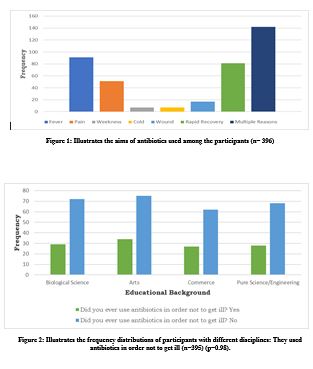
Antimicrobial resistance (AMR) is a growing global health concern threatening both human and animal health. Misuse and overuse of antibiotics, especially through self-medication, are major contributors in developing countries. This study aimed to assess the knowledge, attitude, and practices regarding antibiotic misuse and AMR among university students in Bangladesh. A cross-sectional questionnairebased survey was conducted from September 2024 to February 2025 among 398 students from different disciplines at the University of Rajshahi. Systematic random sampling was applied, and the data were analyzed by using SPSS, version 27, to identify associations with socio-demographic factors. Overall knowledge of antibiotics and AMR was unsatisfactory. While 90.7% of students knew about antibiotics, only 64.07% and 63.32% were aware of antimicrobial drugs and AMR, respectively. Science students showed significantly higher AMR awareness (p<0.001) than arts and commerce students. About 46.33% practiced self-medication, with males being more prone (p=0.001). Moreover, 40.25% used antibiotics irregularly, and 45.57% stopped treatment once they felt better. Arts students were more likely to discontinue antibiotic courses (p=0.001). Despite moderate awareness, the high prevalence of self-medication and inappropriate antibiotic use among university students remains alarming and highlights the urgent need for targeted educational actions to promote rational antibiotic use.
Full text article
References
Almeshal, N., Foot, H., Clarke, A. L., Chan, A. H. Y., & Horne, R. (2024). Understanding patient demand for and use of antibiotics for upper respiratory tract infection: A qualitative application of the Necessity-Concerns Framework in Saudi Arabia. Frontiers in Pharmacology, 15, 1399698. DOI:https://doi.org/10.3389/fphar.2024.1399698
Antimicrobial Resistance Collaborators. (2022). Global burden of bacterial antimicrobial resistance in 2019: A systematic analysis. The Lancet, 399(10325), 629–655. DOI:https://doi.org/10.1016/S0140-6736(21)02724-0
Barchitta, M., Sabbatucci, M., Furiozzi, F., Iannazzo, S., Maugeri, A., Maraglino, F., Prato, R., Agodi, A., & Pantosti, A. (2021). Knowledge, attitudes and behaviors on antibiotic use and resistance among healthcare workers in Italy, 2019: investigation by a clustering method. Antimicrobial Resistance & Infection Control, 10(1), 134. DOI:https://doi.org/10.1186/s13756-021-01002-w
Borek, A. J., Edwards, G., Santillo, M., Wanat, M., Glogowska, M., Butler, C. C., Walker, A. S., Hayward, G., & Tonkin-Crine, S. (2023). Re-examining advice to complete antibiotic courses: a qualitative study with clinicians and patients. BJGP open, 7(2). DOI:https://doi.org/10.3399/BJGPO.2022.0170
Buke, C., Hosgor-Limoncu, M., Ermertcan, S., Ciceklioglu, M., Tuncel, M., Köse, T., & Eren, S. (2005). Irrational use of antibiotics among university students. Journal of infection, 51(2), 135–139. DOI:https://doi.org/10.1016/j.jinf.2004.12.001
Egorov, A. M., Ulyashova, M. M., & Rubtsova, M. Y. (2018). Bacterial enzymes and antibiotic resistance. Acta Naturae (англоязычная версия), 10(4(39)), 33–48.
Vanden Eng, J., Marcus, R., Hadler, J. L., Imhoff, B., Vugia, D. J., Cieslak, P. R., Zell, E., Deneen, V., McCombs, K. G., Zansky,
S. M., & Besser, R. E. (2003). Consumer attitudes and use of antibiotics. Emerging infectious diseases, 9(9), 1128. DOI:https://doi.org/10.3201/eid0909.020591
Grigoryan, L., Haaijer-Ruskamp, F. M., Burgerhof, J. G., Mechtler, R., Deschepper, R., Tambic-Andrasevic, A., Andrajati, R., Monnet, D. L., Cunney, R., Di Matteo, A., & Birkin, J. (2006). Self-medication with antimicrobial drugs in Europe. Emerging infectious diseases, 12(3), 452. DOI:https://doi.org/10.3201/eid1203.050992
Hossain, M. J., Kuddus, M. R., & Rahman, S. A. (2021). Knowledge, attitudes, and behavioral responses toward COVID- 19 during early phase in Bangladesh: a questionnaire-based study. Asia Pacific Journal of Public Health, 33(1), 141–144. DOI:https://doi.org/10.1177/1010539520977328
Hossain, M. J., Jabin, N., Ahmmed, F., Sultana, A., Abdur Rahman, S. M., & Islam, M. R. (2023). Irrational use of antibiotics and factors associated with antibiotic resistance: findings from a cross-sectional study in Bangladesh. Health science reports, 6(8), e1465. DOI:https://doi.org/10.1002/hsr2.1465
Javed, S., Ahmad, J., Zareen, Z., Iqbal, Z., Hubab, M., Rehman, M. U., Shakeela, Q., Khan, I., Hayat, A., & Ahmed, S. (2023). Study on awareness, knowledge, and practices towards antibiotic use among the educated and uneducated people of Khyber Pakhtunkhwa Province, Pakistan. ABCS Health Sciences, 48, e023218–e023218. DOI:https://doi.org/10.7322/abcshs.2021168.1881
Llor, C., & Bjerrum, L. (2014). Antimicrobial resistance: risk associated with antibiotic overuse and initiatives to reduce the problem. Therapeutic advances in drug safety, 5(6), 229–241. DOI:https://doi.org/10.1177/2042098614554919
Marzan, M., Islam, D. Z., Lugova, H., Krishnapillai, A., Haque, M., & Islam, S. (2021). Knowledge, attitudes, and practices of antimicrobial
uses and resistance among public university students in Bangladesh. Infection and Drug Resistance, 14, 519–533. DOI:https://doi.org/10.2147/IDR.S289964
Mboya, E. A., Sanga, L. A., & Ngocho, J. S. (2018). Irrational use of antibiotics in the Moshi Municipality Northern Tanzania: a cross sectional study. Pan African Medical Journal, 31(1). DOI:https://doi.org/10.11604/pamj.2018.31.165.15991
Michael, C. A., Dominey-Howes, D., & Labbate, M. (2014). The antimicrobial resistance crisis: causes, consequences, and management. Frontiers in public health, 2, 145. DOI:https://doi.org/10.3389/fpubh.2014.00145
Morgan, D. J., Okeke, I. N., Laxminarayan, R., Perencevich, E. N., & Weisenberg, S. (2011). Non-prescription antimicrobial use worldwide:
a systematic review. The Lancet infectious diseases, 11(9), 692–701. DOI:https://doi.org/10.1016/S1473-3099(11)70054-8
Muscat, M., Monnet, D. L., Klemmensen, T., Grigoryan, L., Hummelshøj Jensen, M., Andersen, M., Haaijer-Ruskamp, F. M., Sar, Muscat, M., Monnet, D. L., & Sar. (2006). Patterns of antibiotic use in the community in Denmark. Scandinavian journal of infectious diseases, 38(8), 597–603. DOI:https://doi.org/10.1080/00365540600606507
Naghavi, M., Vollset, S. E., Ikuta, K. S., Swetschinski, L. R., Gray, A. P., Wool, E. E., Aguilar, G. R., Mestrovic, T., Smith, G., Han, C., & Dekker, D. M. (2024). Global burden of bacterial antimicrobial resistance 1990–2021: a systematic analysis with forecasts to 2050. The Lancet, 404(10459), 1199–1226. DOI:https://doi.org/10.1016/S0140-6736(24)01867-1
Nguyen, N. V., Marothi, Y., & Sharma, M. (2022). Knowledge, attitude, and practice regarding antibiotic use and resistance for upper respiratory tract infections among the population attending a mass gathering in central India: A cross-sectional study. Antibiotics, 11(11), 1473. DOI:https://doi.org/10.3390/antibiotics11111473
O’Neill, J. (2014). Antimicrobial resistance: Tackling a crisis for the health and wealth of nations. https://www.who.int/news/item/29-04-2019-new-report-callsfor- urgent-action-to-avert-antimicrobial-resistance-crisis
Roca, I., Akova, M., Baquero, F., Carlet, J., Cavaleri, M., Cohen, J., Findlay, D., Gyssens, I., Heure, O. E., & Vila, J. (2015). The global threat of antimicrobial resistance: science for intervention. New microbes and new infections, 6, 22–29. DOI:https://doi.org/10.1016 j.nmni.2015.02.007
Salam, M. A., Al-Amin, M. Y., Salam, M. T., Pawar, J. S., Akhter, N., Rabaan, A. A., & Alqumber, M. A. (2023). Antimicrobial resistance: a growing serious threat for global public health. Healthcare, 11(13), 1946. DOI:https://doi.org/10.3390/healthcare11131946
Shahpawee, N. S., Chaw, L. L., Muharram, S. H., Goh, H. P., Hussain, Z., & Ming, L. C. (2020). University students’ antibiotic use and knowledge of antimicrobial resistance: what are the common myths?. Antibiotics, 9(6), 349. DOI:https://doi.org/10.3390/antibiotics9060349
Siam, M. H. B., Imran, A., Limon, M. B. H., Zahid, M. H., Hossain, M. A., Siddique, M. A., Sultana, M., & Hossain, M. A. (2021). Antibiotic Abuse: A Cross-Sectional Study on Knowledge, Attitude, and Behavior Among the University Students in Dhaka, Bangladesh. Electronic Journal of General Medicine, 18(3). DOI:https://doi.org/10.29333/ejgm/10836
Simegn, W., & Moges, G. (2022). Awareness and knowledge of antimicrobial resistance and factors associated with knowledge among adults in Dessie City, Northeast Ethiopia: Communitybased cross-sectional study. Plos one, 17(12), e0279342. DOI:https://doi.org/10.1371/journal.pone.0279342
Singh-Phulgenda, S., Antoniou, P., Wong, D. L. F., Iwamoto, K., & Kandelaki, K. (2023). Knowledge, attitudes and behaviors on antimicrobial resistance among general public across 14 member states in the WHO European region: results from a cross-sectional survey. Frontiers in public health, 11, 1274818. DOI:https://doi.org/10.3389/fpubh.2023.1274818
World Health Organization. (2015). Global action plan on antimicrobial resistance. World Health Organization. https://apps.who.int/iris/handle/10665/193736
World Health Organization. (2023). Antimicrobial resistance. Geneva: World Health Organization. https://www.who.int/newsroom/
fact-sheets/detail/antimicrobial-resistance
Yamane, T. (1973). Statistics: An introductory analysis.
El Zowalaty, M. E., Belkina, T., Bahashwan, S. A., El Zowalaty, A. E., Tebbens, J. D., Abdel-Salam, H. A., Khalil, A. I., Daghriry, S. I., Gahtani, M. A., Madkhaly, F. M., & Vlček, J. (2016). Knowledge, awareness, and attitudes toward antibiotic use and antimicrobial resistance among Saudi population. International journal of clinical pharmacy, 38(5), 1261–1268. DOI:https://doi.org/10.1007/s11096-016-0362-x
Authors
Copyright (c) 2026 Md. Rimon Bhuiyan, Md. Niamot Ali, Nazmush Shayer Hiya, Asma Khatun, Sadia Binte Shafiq, Syeda Shamapika Ahmed Shimi, and Md. Muhtasim Munif Fahim, Imtiaj Hasan

This work is licensed under a Creative Commons Attribution-NonCommercial-ShareAlike 4.0 International License.
Authors who publish with this journal agree to the following terms:
- Authors retain copyright and grant the journal right of first publication with the work simultaneously licensed under a Creative Commons Attribution License [CC BY-NC-SA 4.0] that allows others to share the work with an acknowledgment of the work's authorship and initial publication in this journal.
- Authors are able to enter into separate, additional contractual arrangements for the non-exclusive distribution of the journal's published version of the work, with an acknowledgment of its initial publication in this journal.
- Authors are permitted and encouraged to post their work online.