
SYNTHESIS, SPECTROSCOPIC CHARACTERIZATION, AND COMPARATIVE ANTIBACTERIAL SCREENING OF CONDENSATION-DERIVED Cu (II) AND Zn(II) COMPLEXES

Article Sidebar
-
Condensation‑derived ligand, Copper(II) complex, Zinc(II) complex, Coordination chemistry, Antibacterial activity
Abstract
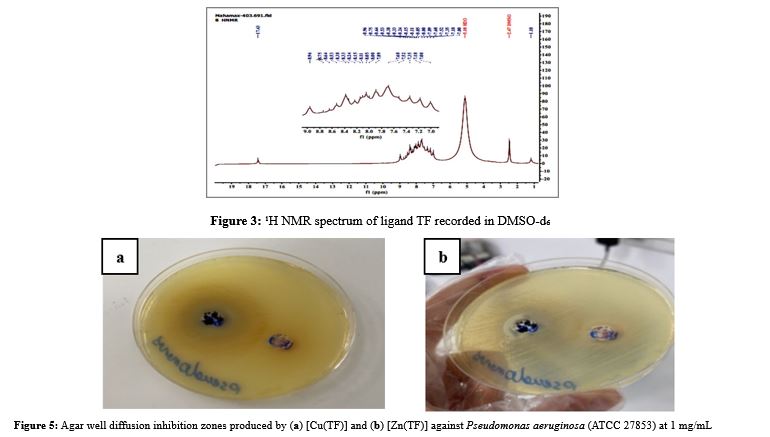
Condensation-derived ligands and their transition metal complexes continue to attract interest due to their structural versatility and potential biological applications. In this study, the tetraaza ligand 2,5,7,10-tetraaza-1,6(1,3)-dibenzenacyclodecaphene-3,4,8,9-tetraone (TF) was synthesized via a microwave-assisted protocol and coordinated with Cu(II) and Zn(II) ions. The ligand and its complexes were characterized by elemental analysis, FTIR, UV–Vis spectroscopy, molar conductance, NMR spectroscopy (ligand), and magnetic measurements. Metal content analysis supports a 1:1 metal–ligand stoichiometry, and the complexes are tentatively formulated as [M(TF)] (M = Cu(II), Zn(II)). Spectroscopic data indicate predominant coordination through nitrogen donor atoms, while carbonyl groups remain non-coordinating. The Cu(II) complex exhibited paramagnetic behavior consistent with a configuration; whereas, the Zn(II) analogue was diamagnetic. Antibacterial activity evaluated against Staphylococcus aureus and Pseudomonas aeruginosa revealed enhanced activity for the Cu(II) complex compared to the Zn(II) complex and the free ligand. Although metal coordination significantly influenced antibacterial performance, definitive structural and mechanistic investigations are required to establish detailed structure–activity relationships.
Full text article
References
Al-Obedi, A. D., & Al-Nama, K. S. (2025). Computational binding studies and bioactivity evaluation for certain Schiff base metal-complexes transformed from ciprofloxacin. Kimya Problemleri, 23(3), 449–461. https://doi.org/10.32737/32221-38688-2025-32733-32449-32461
Alfonso-Herrera, L. A., Rosete-Luna, S., Hernández-Romero, D., Rivera-Villanueva, J. M., Olivares-Romero, J. L., Cruz-Navarro, J. A., et al. (2022). Transition metal complexes with tridentate Schiff bases (ONO and ONN) derived from salicylaldehyde: An analysis of their potential anticancer activity. ChemMedChem, 17(20), e202200367. https://doi.org/10.1002/cmdc.202200367
Ali, E. M., Iqbal, A., Ibrahim, M. N. M., Alheety, M. A., Ahmed, N. M., Yanto, D. H. Y., et al. (2024). Magnetic attapulgite synthesized via sonochemistry: An innovative strategy for efficient solid-phase extraction of As³⁺ from simulated and unrefined crude oil samples. Journal of Porous Materials, 31(4), 1183–1195. https://doi.org/10.1007/s10934-024-01581-9
Almatroudi, A. (2025). Biofilm resilience: Molecular mechanisms driving antibiotic resistance in clinical contexts. Biology, 14(2), 165. https://doi.org/10.3390/biology14020165
Claudel, M., Schwarte, J. V., & Fromm, K. M. (2020). New antimicrobial strategies based on metal complexes. Chemistry, 2(4), 849–899. https://doi.org/10.3390/chemistry2040056
El-Lateef, H. M. A., El-Dabea, T., Khalaf, M. M., & Abu-Dief, A. M. (2023). Recent overview of potent antioxidant activity of coordination compounds. Antioxidants, 12(2), 213. https://doi.org/10.3390/antiox12020213
El-Shafiy, H. F., Saif, M., Mashaly, M. M., Halim, S. A., Eid, M. F., Nabeel, A., et al. (2017). New nano-complexes of Zn(II), Cu(II), Ni(II) and Co(II) ions: Spectroscopy, thermal, structural analysis, DFT calculations and antimicrobial activity application. Journal of Molecular Structure, 1147, 452–461. https://doi.org/10.1016/j.molstruc.2017.06.112
Eshankulov, K. N., Turaev, K. K., Geldiev, Y., Nomozov, A., Eshankulov, S., Musaev, C. A., et al. (2025). Studying of metal-containing acrylic copolymers and sulfur-modified bitumen BH 90/30. Kimya Problemleri, 23(2), 202–213. https://doi.org/10.32737/32221-38688-2025-32732-32202-32213
Fakhree, M., & Dawood, S. K. (2019). Preparation and characterization of some transition metal complexes with two mixed ligands macrocyclic and PPh₃ ligands. Rafidain Journal of Science, 28(5), 29–37. https://doi.org/10.33899/rjs.2019.163294
Jackman, L. M., & Sternhell, S. (1969). Applications of nuclear magnetic resonance in organic chemistry (2nd ed.). Pergamon Press.
Khan, E., Hanif, M., & Akhtar, M. S. (2022). Schiff bases and their metal complexes with biologically compatible metal ions: Biological importance, recent trends and future hopes. Reviews in Inorganic Chemistry, 42(4), 307–325. https://doi.org/10.1515/revic-2021-0034
Kollef, M. H., Torres, A., Shorr, A. F., Martin-Loeches, I., & Micek, S. T. (2021). Nosocomial infection. Critical Care Medicine, 49(2), 169–187. https://doi.org/10.1097/CCM.0000000000004783
Kostova, I. (2023). The role of complexes of biogenic metals in living organisms. Inorganics, 11(2), 56. https://doi.org/10.3390/inorganics11020056
Liu, X., Ma, Z., Xing, J., & Liu, H. (2004). Preparation and characterization of amino-silane modified superparamagnetic silica nanospheres. Journal of Magnetism and Magnetic Materials, 270(1–2), 1–6. https://doi.org/10.1016/j.jmmm.2003.07.006
Mañozca-Dosman, I. V., Aragón-Muriel, A., & Polo-Cerón, D. (2025). Antibacterial activity of metal complexes of Cu(II) and Ni(II) with the ligand 2-(phenylsubstituted) benzimidazole. Scientia Pharmaceutica, 93(2), 22. https://doi.org/10.3390/scipharm93020022
Maurice, P. A. (1996). Applications of atomic-force microscopy in environmental colloid and surface chemistry. Colloids and Surfaces A: Physicochemical and Engineering Aspects, 107, 57–75. https://doi.org/10.1016/0927-7757(95)03372-6
Mohammed, E. H., AlSultan, M., Alasalli, S. M., & Sabah, A. A. (2025). Syntheses, characterization and thermal stability study of new Co(II), Cu(II) and Zn(II) complexes derived from Schiff base 4-(dimethylamino)benzaldehyde. Kimya Problemleri, 23(3), 395–406. https://doi.org/10.32737/32221-38688-2025-32733-32395-32406
Muteeb, G., Rehman, M. T., Shahwan, M., & Aatif, M. (2023). Origin of antibiotics and antibiotic resistance, and their impacts on drug development: A narrative review. Pharmaceuticals, 16(11), 1615. https://doi.org/10.3390/ph16111615
Nazirkar, B., Mandewale, M., & Yamgar, R. (2019). Synthesis, characterization and antibacterial activity of Cu(II) and Zn(II) complexes of 5-aminobenzofuran-2-carboxylate Schiff base ligands. Journal of Taibah University for Science, 13(1), 440–449. https://doi.org/10.1080/16583655.2019.1592316
Riccardi, L., Genna, V., & De Vivo, M. (2018). Metal–ligand interactions in drug design. Nature Reviews Chemistry, 2(7), 100–112. https://doi.org/10.1038/s41570-018-0018-6
Salam, M. A., Al-Amin, M. Y., Salam, M. T., Pawar, J. S., Akhter, N., Rabaan, A. A., et al. (2023). Antimicrobial resistance: A growing serious threat for global public health. Healthcare, 11, 1947. https://doi.org/10.3390/healthcare11131947
Sinicropi, M. S., Ceramella, J., Iacopetta, D., Catalano, A., Mariconda, A., Rosano, C., et al. (2022). Metal complexes with Schiff bases: Data collection and recent studies on biological activities. International Journal of Molecular Sciences, 23(23), 14840. https://doi.org/10.3390/ijms232314840
Szarszoń, K., Andrä, S., Janek, T., & Wą tły, J. (2024). Insights into the chemistry, structure, and biological activity of human salivary MUC7 fragments and their Cu(II) and Zn(II) complexes. Inorganic Chemistry, 63(25), 11616–11627. https://doi.org/10.1021/acs.inorgchem.4c00868
Authors
Copyright (c) 2026 Falah M. Darweesh, Muzhda Q. Qader, Sewgil S. Anwer, Lubna A. Abdulkarim, Thana Y. Yousif, and R. Ranjith Kumar

This work is licensed under a Creative Commons Attribution-NonCommercial-ShareAlike 4.0 International License.
Authors who publish with this journal agree to the following terms:
- Authors retain copyright and grant the journal right of first publication with the work simultaneously licensed under a Creative Commons Attribution License [CC BY-NC-SA 4.0] that allows others to share the work with an acknowledgment of the work's authorship and initial publication in this journal.
- Authors are able to enter into separate, additional contractual arrangements for the non-exclusive distribution of the journal's published version of the work, with an acknowledgment of its initial publication in this journal.
- Authors are permitted and encouraged to post their work online.