
EFFECT OF CHITOSAN AND PUTRESCINE-ANCHORED NANOCARBON ON THE in vitro PROPAGATION OF THE APPLE ROOTSTOCK MM106

Article Sidebar
-
Apple, Micropropagation, Chitosan, Carbon nanotube, putrescine, Phloroglucinol
Abstract
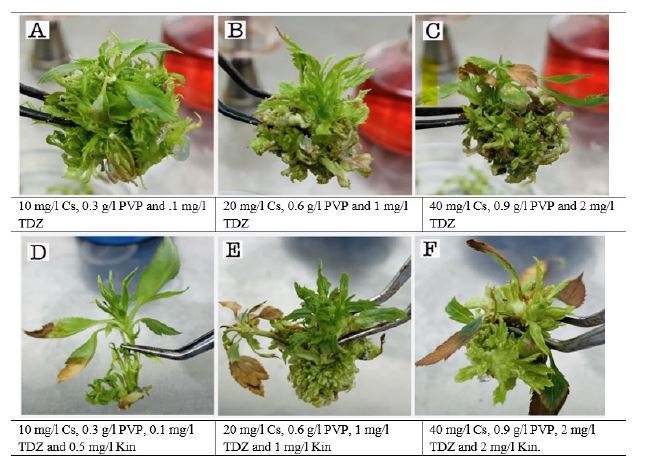
Apple is one of the most important fruit crops cultivated in temperate regions worldwide. This study aimed to develop an efficient protocol for shoot multiplication and root induction during the in vitro propagation of the apple rootstock MM106. The results showed that the MM106 rootstock responded variably to chitosan (CS), polyvinylpyrrolidone (PVP), and thidiazuron (TDZ) concentrations during micropropagation. The highest shoot multiplication rate and shoot quality were obtained on MS medium supplemented with 0.1 mg L⁻¹ TDZ, 10 mg L⁻¹ CS, and 0.3 g L⁻¹ PVP during the long phase of shoot multiplication on the MS-medium. The addition of kinetin to the TDZ–CS–PVP combinations reduced the shoot multiplication rate. 1 mg/L IBA with 0.3 g/l PVP was the most effective concentration in the rooting phase, and 83.3% of shoots were rooted by adding carbon nanotubes (CNTs), putrescine (Put), or phloroglucinol (PG) separately at varying concentrations (with IBA + PVP) significantly increased rooting percentage, root number per shoot, root length, rooting speed, and lateral roots.
Full text article
References
Adiletta, G., Di Matteo, M., & Petriccione, M. (2021). Multifunctional role of chitosan edible coatings on antioxidant systems in fruit crops: A review. International Journal of Molecular Sciences, 22(5), 1–18. https://doi.org/10.3390/ijms22052633
Amiri, E. M., & Elahinia, A. (2011). Optimization of medium composition for apple rootstocks. African Journal of Biotechnology, 10(18), 3594–3601. https://doi.org/10.5897/AJB10.1945
Asgari-Targhi, G., Iranbakhsh, A., & Ardebili, Z. O. (2018). Potential benefits and phytotoxicity of bulk and nano-chitosan on the growth, morphogenesis, physiology, and micropropagation of Capsicum annuum. Plant Physiology and Biochemistry, 127, 393–402. https://doi.org/10.1016/j.plaphy.2018.04.013
Bhatia, S., & Sharma, K. (2015). Micropropagation. Modern Applications of Plant Biotechnology in Pharmaceutical Sciences, 361–368. https://doi.org/10.1016/B978-0-12-802221-4.00011-X
Castillo, A., Cabrera, D., Rodríguez, P., Zoppolo, R., & Robinson, T. (2015). In vitro micropropagation of CG41 apple rootstock. Acta Horticulturae, 1083, 569–576. https://doi.org/10.17660/actahortic.2015.1083.76
Dobránszki, J., & Teixeira da Silva, J. A. (2010). Micropropagation of apple - A review. Biotechnology Advances, 28(4), 462–488. https://doi.org/10.1016/j.biotechadv.2010.02.008
George, E. F., Hall, M. A., & Klerk, G. J. De. (2008). Plant propagation by tissue culture 3rd edition. In Plant Propagation by Tissue Culture 3rd Edition (Vol. 1). https://doi.org/10.1007/978-1-4020-5005-3
Haaf, F., Sanner, A., & Straub, F. (1985). Polymers of n-vinylpyrrolidone: Synthesis, characterization and uses. In Polymer Journal (Vol. 17, Issue 1, pp. 143–152). https://doi.org/10.1295/polymj.17.143
Kassahun Bantte, D. S., & Feyissa, T. (2015). Effects of Polyvinyl Pyrrolidone and Activated Charcoal to Control Effect of Phenolic Oxidation on In Vitro Culture Establishment Stage of Micropropagation of Sugarcane (Saccharum Officinarum L.). Advances in Crop Science and Technology, 03(04), 10–13. https://doi.org/10.4172/2329-8863.1000184
Kellerhals, M. (2009). Genetics and Genomics of Rosaceae. Genetics and Genomics of Rosaceae, 73–84. https://doi.org/10.1007/978-0-387-77491-6
Lizárraga, A., Fraga, M., Ascasíbar, J., & González, M. L. (2017). <i>In Vitro</i> Propagation and Recovery of Eight Apple and Two Pear Cultivars Held in a Germplasm Bank. American Journal of Plant Sciences, 08(09), 2238–2254. https://doi.org/10.4236/ajps.2017.89150
Malaysiana, S., Penjanaan, P., Pucuk, S., & Biokimia, S. S. (2021). Enhanced in vitro Shoot Regeneration and Biochemical Properties of Stevia rebaudiana using Chitosan. 50(3), 667–676.
Mert, C. İ. Y. E., & Soylu, A. R. İ. F. (2010). Shoot location and collection time effects on meristem tip culture of some apple rootstocks. 42(1), 549–557.
Modgil, M., Sharma, D. R., & Bhardwaj, S. V. (1999). Micropropagtion of apple cv. Tydeman’s Early Worcester. Scientia Horticulturae, 81(2), 179–188. https://doi.org/10.1016/S0304-4238(98)00259-3
Mustafa, N. S., Taha, R. A., Hassan, S. A. M., Zaid, N. S. M., & Mustafa, E. A. (2013). Overcoming phenolic accumulation of date palm in vitro culture using α-tochopherol and cold pre-treatment. Middle East Journal of Scientific Research, 15(3), 344–350. https://doi.org/10.5829/idosi.mejsr.2013.15.3.11080
Naija, S., Elloumi, N., Ammar, S., Kevers, C., & Dommes, J. (2009). Involvement of polyamines in the adventitious rooting of micropropagated shoots of the apple rootstock MM106. In Vitro Cellular and Developmental Biology - Plant, 45(1), 83–91. https://doi.org/10.1007/s11627-008-9165-7
Nge, K. L., Nwe, N., Chandrkrachang, S., & Stevens, W. F. (2006). Chitosan as a growth stimulator in orchid tissue culture. Plant Science, 170(6), 1185–1190. https://doi.org/10.1016/j.plantsci.2006.02.006
Podwyszyńska, M., & Cieślińska, M. (2018). ROOTING SHOOTS OF APPLE VARIETIES AND THEIR TETRAPLOIDS OBTAINED BY THE in vitro TECHNIQUE. 17(1), 49–62. https://doi.org/10.24326/asphc.2018.1.5
Sarwar, M., & Skirvin, R. M. (1997). Effect of thidiazuron and 6-benzylaminopurine on adventitious shoot regeneration from leaves of three strains of “McIntosh” apple (Malus X domestica Borkh.) in vitro. Scientia Horticulturae, 68(1–4), 95–100. https://doi.org/10.1016/S0304-4238(96)00971-5
Sharif, R., Mujtaba, M., Rahman, M. U., Shalmani, A., Ahmad, H., Anwar, T., Tianchan, D., & Wang, X. (2018). The multifunctional role of chitosan in horticultural crops; a review. Molecules, 23(4), 1–20. https://doi.org/10.3390/molecules23040872
Sharma, M., Modgil, M., & Sharma, D. R. (2000). Successful propagation in vitro of apple rootstock MM106 and influence of phloroglucinol. Indian Journal of Experimental Biology, 38(12), 1236–1240.
Taha, R. A., Hassan, M. M., Ibrahim, E. A., Abou Baker, N. H., & Shaaban, E. A. (2016). Carbon nanotubes impact on date palm in vitro cultures. Plant Cell, Tissue and Organ Culture, 127(2), 525–534. https://doi.org/10.1007/s11240-016-1058-6
Tashmatova, L. V, Matsneva, O. V, Khromova, T. M., & Shakhov, V. V. (2021). Influence of different concentrations of 6- benzylaminopurine and thidiazuron on the proliferative activity of apple varieties in in vitro culture. 03012, 1–7.
Teixeira da Silva, J. A., Gulyás, A., Magyar-Tábori, K., Wang, M. R., Wang, Q. C., & Dobránszki, J. (2019). In vitro tissue culture of apple and other Malus species: recent advances and applications. In Planta (Vol. 249, Issue 4). Springer Berlin Heidelberg. https://doi.org/10.1007/s00425-019-03100-x
Uthairatanakij, A., Teixeira da Silva, J. a, & Obsuwan, K. (2007). Chitosan for improving orchid production and quality. Orchid Science and Biotechnology, 1(1), 1–5. http://www.globalsciencebooks.info/JournalsSup/images/Sample/OSB_1(1)1-5.pdf
Vettori, L., Russo, A., Felici, C., Fiaschi, G., Morini, S., & Toffanin, A. (2010). Improving micropropagation: Effect of azospirillum brasilense Sp245 on acclimatization of rootstocks of fruit tree. Journal of Plant Interactions, 5(4), 249–259. https://doi.org/10.1080/17429145.2010.511280
Yan, S., Zhao, L., Li, H., Zhang, Q., Tan, J., Huang, M., He, S., & Li, L. (2013). Single-walled carbon nanotubes selectively influence maize root tissue development accompanied by the change in the related gene expression. Journal of Hazardous Materials, 246–247, 110–118. https://doi.org/10.1016/j.jhazmat.2012.12.013
Zhang, X., Qin, Y., Liang, D., Zou, Y., & Ma, F. (2014). Enhancement of in vitro shoot regeneration from leaf explants of apple rootstock G.41. In Vitro Cellular and Developmental Biology - Plant, 50(2), 263–270. https://doi.org/10.1007/s11627-013-9588-7
Authors
Copyright (c) 2026 Ihsan N. Alzebari, Mohammedreza Dadpour, Sima Panahirad, and Saeed Mezgeen Saeed Zeebaree

This work is licensed under a Creative Commons Attribution-NonCommercial-ShareAlike 4.0 International License.
Authors who publish with this journal agree to the following terms:
- Authors retain copyright and grant the journal right of first publication with the work simultaneously licensed under a Creative Commons Attribution License [CC BY-NC-SA 4.0] that allows others to share the work with an acknowledgment of the work's authorship and initial publication in this journal.
- Authors are able to enter into separate, additional contractual arrangements for the non-exclusive distribution of the journal's published version of the work, with an acknowledgment of its initial publication in this journal.
- Authors are permitted and encouraged to post their work online.