
SECOND LIFE ASSESSMENT OF SALVAGED 18650 LITHIUM-ION CELLS USING CAPACITY AND INTERNAL RESISTANCE METRICS

Article Sidebar
-
Lithium-Ion Batteries, Second-Life, State-of-Health, Internal Resistance, Battery Degradation
Abstract
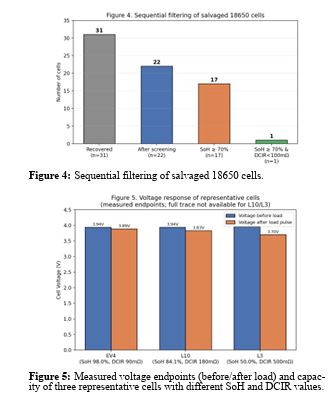
The increasing waste stream of end-of-first-life lithium-ion batteries poses an important challenge and a circular economy opportunity via second-life applications. Nonetheless, trusted characterisation strategies are critical for confirming the safety and functionality of repurposed cells. This study analyses the viability of 18650 cells salvaged from laptop, power tool, and electric vehicle (EV) battery packs according to a dual-parameter framework based on residual capacity (State of Health, SoH) and DC internal resistance (DCIR). Measured SoH ranged from 50.0% to 98.0%, and DCIR ranged from 90 to 500 mΩ across the 22 characterised cells. This is, to our knowledge, among the first studies to combine dual-parameter screening with an explicit threshold sensitivity analysis across three distinct salvaged cell chemistries. Although 77.3% of the 22 characterised cells continued to possess a SoH ≥ 70%, only one cell (4.5%) passed a conservative reuse threshold in which both SoH ≥ 70% and the direct current internal resistance (DCIR) were < 100 mΩ. SoH showed a strong inverse correlation with DCIR (Pearson r = −0.76, R² = 0.57). Cells from the EV system showed maximum SoH retention with fair DCIR readings. The findings show that internal resistance, rather than capacity fade alone, is a key limiting factor to second-life applicability for power-demanding uses and highlight the need for multi-parameter screening protocols including resistance to reduce risks of unwanted low-performing battery reuse.
Full text article
References
Akram, M. N., & Abdul-Kader, W. (2024). Repurposing Second-Life EV Batteries to Advance Sustainable Development: A Comprehensive Review. Batteries, 10(12), 452. https://doi.org/10.3390/batteries10120452
Barré, A., Deguilhem, B., Grolleau, S., Gérard, M., Suard, F., & Riu, D. (2013). A review on lithium-ion battery ageing mechanisms and estimations for automotive applications. Journal of Power Sources, 241, 680–689. https://doi.org/10.1016/j.jpowsour.2013.05.040
Birkl, C. R., Roberts, M. R., McTurk, E., Bruce, P. G., & Howey, D. A. (2017). Degradation diagnostics for lithium ion cells. Journal of Power Sources, 341, 373–386. https://doi.org/10.1016/j.jpowsour.2016.12.011
Blomgren, G. E. (2017). The development and future of lithium ion batteries. Journal of The Electrochemical Society, 164(1), A5019–A5025. https://doi.org/10.1149/2.0251701jes
Christensen, P. A., Anderson, P. A., Harper, G. D. J., Lambert, S. M., Mrozik, W., Rajaeifar, M. A., Wise, M. S., & Heidrich, O. (2021). Risk management over the life cycle of lithium-ion batteries in electric vehicles. Renewable and Sustainable Energy Reviews, 148, 111240. https://doi.org/10.1016/j.rser.2021.111240
Dubarry, M., & Liaw, B. Y. (2009). Identify capacity fading mechanism in a commercial LiFePO4 cell. Journal of Power Sources, 194(1), 541–549. https://doi.org/10.1016/j.jpowsour.2009.05.036
Fan, M., Geng, M., Yang, K., Zhang, M., & Liu, H. (2023). State of health estimation of lithium-ion battery based on electrochemical impedance spectroscopy. Energies, 16(8), 3393. https://doi.org/10.3390/en16083393
Feng, X., Ouyang, M., Liu, X., Lu, L., Xia, Y., & He, X. (2018). Thermal runaway mechanism of lithium ion battery for electric vehicles: A review. Energy Storage Materials, 10, 246–267. https://doi.org/10.1016/j.ensm.2017.05.013
George, R. O., Ugwu, S. N., Nwulu, N., & Ezema, F. I. (2023). Characterization and energy storage performance assessment of repurposed 18650 cylindrical lithium-ion cells for second life application in battery energy storage systems. MRS Advances, 8(15), 860–870. https://doi.org/10.1557/s43580-023-00661-8
Guo, R., Lu, L., Ouyang, M., & Feng, X. (2016). Mechanism of the entire overdischarge process and overdischarge-induced internal short circuit in lithium-ion batteries. Scientific Reports, 6, 30248. https://doi.org/10.1038/srep30248
Islam, M. T., & Iyer-Raniga, U. (2022). Lithium-ion battery recycling in the circular economy: A review. Recycling, 7(3), 33. https://doi.org/10.3390/recycling7030033
Keil, P., & Jossen, A. (2015). Aging of lithium-ion batteries in electric vehicles: Impact of regenerative braking. World Electric Vehicle Journal, 7(1), 41–51. https://doi.org/10.3390/wevj7010041
Kok, C. L., How Koh, K., Ho, C. K., & Lee, C. (2024). Innovative charging solutions for Li-ion batteries in UPS systems: A microcontroller-based design. 2024 IEEE 17th International Symposium on Embedded Multicore/Many-Core Systems-on-Chip (MCSoC), pp. 46–49. https://doi.org/10.1109/MCSoC64144.2024.00017
Langner, T., Sieber, T., & Acker, J. (2021). Studies on the deposition of copper in lithium-ion batteries during the deep discharge process. Scientific Reports, 11(1), 6316. https://doi.org/10.1038/s41598-021-85575-x
Lin, X., Kim, Y., Mohan, S., Siegel, J. B., & Stefanopoulou, A. G. (2019). Modeling and estimation for advanced battery management. Annual Review of Control, Robotics, and Autonomous Systems, 2(1), 393–426. https://doi.org/10.1146/annurev-control-053018-023643
Liu, J., & Wang, X. (2024). Experimental study of the effect of different pulse charging patterns on lithium-ion battery charging. Journal of Power Sources, 610, 234700. https://doi.org/10.1016/j.jpowsour.2024.234700
Luo, Y., Wei, H., Tang, L., Huang, Y., Wang, Z., He, Z., Yan, C., Mao, J., Dai, K., & Zheng, J. (2022). Nickel-rich and cobalt-free layered oxide cathode materials for lithium ion batteries. Energy Storage Materials, 50, 274–307. https://doi.org/10.1016/j.ensm.2022.05.019
Maddipatla, S., Rauf, H., Osterman, M., Arshad, N., & Pecht, M. (2025). Swelling mechanisms, diagnostic applications, and mitigation strategies in lithium-ion batteries. Batteries, 11(10), 356. https://doi.org/10.3390/batteries11100356
Mandli, A. R., Kaushik, A., Patil, R. S., Naha, A., Hariharan, K. S., Kolake, S. M., Han, S., & Choi, W. (2019). Analysis of the effect of resistance increase on the capacity fade of lithium ion batteries. International Journal of Energy Research, 43(6), 2044–2056. https://doi.org/10.1002/er.4397
Montes, T., Etxandi-Santolaya, M., Eichman, J., Ferreira, V. J., Trilla, L., & Corchero, C. (2022). Procedure for assessing the suitability of battery second life applications after EV first life. Batteries, 8(9), 122. https://doi.org/10.3390/batteries8090122
Nazim, M. S., & Madurai Elavarasan, R. (2026). Extending battery lifecycles: A holistic review of second-life lithium-ion technology in sustainable energy systems from assessment to emerging trends. Renewable and Sustainable Energy Reviews, 233, 116848. https://doi.org/10.1016/j.rser.2026.116848
Neubauer, J., & Pesaran, A. (2011). The ability of battery second use strategies to impact plug-in electric vehicle prices and serve utility energy storage applications. Journal of Power Sources, 196(23), 10351–10358. https://doi.org/10.1016/j.jpowsour.2011.06.053
Neubauer, J., Smith, K., Wood, E., & Pesaran, A. (2015). Identifying and overcoming critical barriers to widespread second use of PEV batteries. National Renewable Energy Laboratory. https://doi.org/10.2172/1171780
Patel, A. N., Lander, L., Ahuja, J., Bulman, J., Lum, J. K. H., Pople, J. O. D., Hales, A., Patel, Y., & Edge, J. S. (2024). Lithium-ion battery second life: pathways, challenges and outlook. Frontiers in Chemistry, 12. https://doi.org/10.3389/fchem.2024.1358417
Pillai, P., Desai, S., Pattipati, K. R., & Balasingam, B. (2025). An improved approach to estimate the internal resistance of a battery during the HPPC test. http://arxiv.org/abs/2505.06410
Rodrigues, M.-T. F., Babu, G., Gullapalli, H., Kalaga, K., Sayed, F. N., Kato, K., Joyner, J., & Ajayan, P. M. (2017). A materials perspective on Li-ion batteries at extreme temperatures. Nature Energy, 2(8), 17108. https://doi.org/10.1038/nenergy.2017.108
Salinas, F., Krüger, L., Neupert, S., & Kowal, J. (2019). A second life for li-ion cells rescued from notebook batteries. Journal of Energy Storage, 24, 100747. https://doi.org/10.1016/j.est.2019.04.021
Schweiger, H.-G., Obeidi, O., Komesker, O., Raschke, A., Schiemann, M., Zehner, C., Gehnen, M., Keller, M., & Birke, P. (2010). Comparison of several methods for determining the internal resistance of lithium ion cells. Sensors, 10(6), 5604–5625. https://doi.org/10.3390/s100605604
Stanchev, P., & Hinov, N. (2025). Comparative techno-economic and life cycle assessment of stationary energy storage systems: Lithium-ion, lead-acid, and hydrogen. Batteries, 11(10), 382. https://doi.org/10.3390/batteries11100382
Tian, Y., Wang, Q., & Liu, J. (2022). Analysis of lithium-ion battery through direct current internal resistance characteristic. SAE International Journal of Electrified Vehicles, 12(2), 14-12-02–0009. https://doi.org/10.4271/14-12-02-0009
Wheeler, W., Bultel, Y., Venet, P., & Sari, A. (2025). An ageing study of twenty 18650 lithium-ion Graphite/LFP cells in first and second life use. Scientific Data. https://doi.org/10.1038/s41597-025-04712-7
Zhang, S. S. (2006). The effect of the charging protocol on the cycle life of a Li-ion battery. Journal of Power Sources, 161(2), 1385–1391. https://doi.org/10.1016/j.jpowsour.2006.06.040
Authors
Copyright (c) 2026 Linus Kweku Labik , Felix Asirifi Asare, Daniel Junior Awuku Larbi, Bright Senyo Freeman, Nicholas Blepo Tetteh, and Wilhelmina Sharon Jones

This work is licensed under a Creative Commons Attribution-NonCommercial-ShareAlike 4.0 International License.
Authors who publish with this journal agree to the following terms:
- Authors retain copyright and grant the journal right of first publication with the work simultaneously licensed under a Creative Commons Attribution License [CC BY-NC-SA 4.0] that allows others to share the work with an acknowledgment of the work's authorship and initial publication in this journal.
- Authors are able to enter into separate, additional contractual arrangements for the non-exclusive distribution of the journal's published version of the work, with an acknowledgment of its initial publication in this journal.
- Authors are permitted and encouraged to post their work online.