
STUDIES OF LIVER BIOMARKER (ASPARTATE AMINOTRANSFERASE, ALANINEAMINOTRANSFERASE, GAMMA-GLYTAMYL TRANSFERASE, ALKALINE PHOSPHATASES) IN ADOLESCENTS WHO CONSUME ALCOHOL : A SYSTEMATIC REVIEW

Article Sidebar
-
Adolescents, Alcohol, Hepatic Biomarkers, Alcohol-Associated Liver Disease
Abstract
Excessive alcohol consumption among adolescents and young adults is an emerging public health issue that can lead to early-onset hepatic abnormalities. Biological biomarkers could help identify at-risk individuals, yet their diagnostic performance and interpretation in young people remain inconsistent. The aim of this review is to systematically evaluate the association between alcohol consumption and hepatic biomarkers (Alanine aminotransferase, aspartate aminotransferase, gamma-glutamyl transferase,
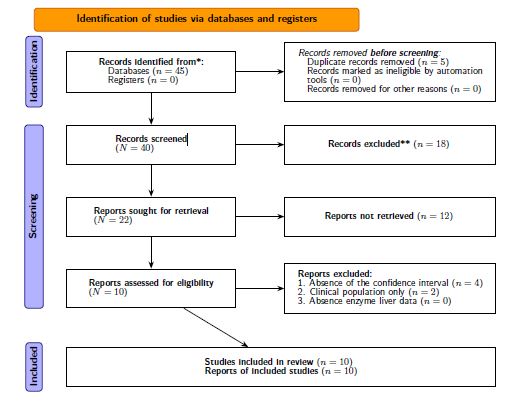
and alkaline phosphatase) in adolescents. The protocol for this systematic review was registered on PROSPERO (reference CRD420261395876. We conducted a systematic review and meta-analysis in accordance with PRISMA guidelines. A comprehensive search was performed across several databases: PubMed, Scopus, Web of Science Core Collection, PsycINFO, the Cochrane Library, Cairn, and ScienceDirect. The methodological quality of the observational studies was assessed using the Newcastle- Ottawa scale. Among excessive consumers, MCV was significantly higher than in subjects without alcohol abuse (89.94 vs. 87.59 fL; p = 0.001), as was ALT (32.27 vs. 24.03 IU/L; p = 0.038). AST exhibited a trend toward elevation, although the increase did not reach statistical significance (p = 0.064). In subjects with alcohol-associated liver disease, ALT was significantly elevated (41.55 vs. 20.24 IU/L ; p = 0.042). Diagnostic performance varied: sensitivity ranged from 37–85% for GGT and 20–70% for MCV. An AST/ALT ratio > 2 showed high specificity (92–100%). The combination of GGT and MCV achieved a sensitivity of 95%. Enzyme levels were influenced by age, BMI-SDS, and pubertal stage. No single hepatic biomarker allows for the sufficiently accurate screening of excessive alcohol consumption in adolescents and young adults. MCV and ALT appear to be particularly informative parameters, while combining multiple biomarkers could improve screening. Integrating direct biomarkers of consumption specifically phosphatidylethanol with clinical, metabolic, and hepatic assessments could improve the early identification of at-risk youth.
Full text article
References
Arab, J. P., Díaz, L. A., Rehm, J., Im, G., Arrese, M., Kamath, P. S., Lucey, M. R., Mellinger, J., Thiele, M., Thursz, M., Bataller,
R., Burton, R., Chokshi, S., Francque, S. M., Krag, A., Lackner, C., Lee, B. P., Liangpunsakul, S., MacClain, C., …Mathurin,
P. (2025). Metabolic dysfunction and alcohol-related liver disease (MetALD): Position statement by an expert panel on alcoholrelated
liver disease. Journal of Hepatology, 82(4), 744-756. DOI:https://doi.org/10.1016/j.jhep.2024.11.028
Arnts, J., Vanlerberghe, B. T. K., Roozen, S., Crunelle, C. L., Masclee, A. A. M., Olde‐Damink, S. W. M., Heeren, R. M. A., Van Nuijs, A., Neels, H., Nevens, F., & Verbeek, J. (2021). Diagnostic Accuracy of Biomarkers of Alcohol Use in Patients With Liver Disease: A Systematic Review. Alcoholism: Clinical and Experimental Research, 45(1), 25-37. DOI:https://doi.org/10.1111/acer.14512
Axley, P. D., Richardson, C. T., & Singal, A. K. (2019). Epidemiology of Alcohol Consumption and Societal Burden of Alcoholism and Alcoholic Liver Disease. Clinics in Liver Disease, 23(1), 39-50. DOI:https://doi.org/10.1016/j.cld.2018.09.011
Binder, C., Knibbe, K., Kreissl, A., Repa, A., Thanhaeuser, M., Greber-Platzer, S., Berger, A., Jilma, B., & Haiden, N. (2016). Does acute alcohol intoxication cause transaminase elevations in children and adolescents? Alcohol, 51, 57-62. DOI:https://doi.org/10.1016 j.alcohol.2015.12.001
Bussler, S., Vogel, M., Pietzner, D., Harms, K., Buzek, T., Penke, M., Händel, N., Körner, A., Baumann, U., Kiess, W., & Flemming, G. (2018). New pediatric percentiles of liver enzyme serum levels (alanine aminotransferase, aspartate aminotransferase,
γ‐glutamyltransferase): Effects of age, sex, body mass index, and pubertal stage. Hepatology, 68(4), 1319-1330.
DOI:https://doi.org/10.1002/hep.29542
Danpanichkul, P., Chen, V. L., Tothanarungroj, P., Kaewdech, A., Kanjanakot, Y., Fangsaard, P., Wattanachayakul, P., Duangsonk,
K., Kongarin, S., Yang, J. D., Wong, R. J., Noureddin, M., Díaz, L. A., Arab, J. P., Liangpunsakul, S., & Wijarnpreecha, K. (2024).
Global epidemiology of alcohol‐associated liver disease in adolescents and young adults. Alimentary Pharmacology & Therapeutics,
60(3), 378-388. DOI:https://doi.org/10.1111/apt.18101
Dunn, N., Al-khouri, N., Abdellatif, I., & Singal, A. K. (2025). Metabolic Dysfunction and Alcohol-Associated Liver Disease: A Narrative Review. Clinical and Translational Gastroenterology, 16(5), e00828. DOI:https://doi.org/10.14309/ctg.0000000000000828
Flemming, J. A., Djerboua, M., Chapman, O., Ayonrinde, O., & Terrault, N. A. (2024). Epidemiology and Outcomes of Alcohol-Associated Hepatitis in Adolescents and Young Adults. JAMA Network Open, 7(12), e2452459. DOI:https://doi.org/10.1001/jamanetworkopen.2024.52459
Gala, K. S., & Vatsalya, V. (2020). Emerging Noninvasive Biomarkers, and Medical Management Strategies for Alcoholic Hepatitis:
Present Understanding and Scope. Cells, 9(3), 524. DOI:https://doi.org/10.3390/cells9030524
Gao, B., & Bataller, R. (2011). Alcoholic Liver Disease: Pathogenesis and New Therapeutic Targets. Gastroenterology, 141(5), 1572-1585. DOI:https://doi.org/10.1053/j.gastro.2011.09.002
Han, S., Yang, Z., Zhang, T., Ma, J., Chandler, K., & Liangpunsakul, S. (2021). Epidemiology of Alcohol-Associated Liver Disease. Clinics in Liver Disease, 25(3), 483-492. DOI:https://doi.org/10.1016/j.cld.2021.03.009
Haren, M. T., Li, M., Petkov, J., & McDermott, R. A. (2010). Alcohol, metabolic risk and elevated serum gamma-glutamyl transferase
(GGT) in Indigenous Australians. BMC Public Health, 10(1), 454. DOI:https://doi.org/10.1186/1471-2458-10-454
Hartling, L., Milne, A., Hamm, M. P., Vandermeer, B., Ansari, M., Tsertsvadze, A., & Dryden, D. M. (2013). Testing the Newcastle Ottawa Scale showed low reliability between individual reviewers. Journal of Clinical Epidemiology, 66(9), 982-993. DOI:https://doi.org/10.1016/j.jclinepi.2013.03.003
Jophlin, L. L., Singal, A. K., Bataller, R., Wong, R. J., Sauer, B. G., Terrault, N. A., & Shah, V. H. (2024). ACG Clinical Guideline: Alcohol-Associated Liver Disease. American Journal of Gastroenterology, 119(1), 30-54. DOI:https://doi.org/10.14309/ajg.0000000000002572
Niemelä, O. (2016). Biomarker-Based Approaches for Assessing Alcohol Use Disorders. International Journal of
Environmental Research and Public Health, 13(2), 166. DOI:https://doi.org/10.3390/ijerph13020166
Pathology of Alcoholic Liver Disease. (2014). Journal of Clinical and Translational Hepatology, 2(2). DOI:https://doi.org/10.14218/JCTH.2014.00010
Patte, K. A., Qian, W., & Leatherdale, S. T. (2017). Binge drinking and academic performance, engagement, aspirations, and expectations: A longitudinal analysis among secondary school students in the COMPASS study. Health Promotion
and Chronic Disease Prevention in Canada, 37(11), 376-385. DOI:https://doi.org/10.24095/hpcdp.37.11.02
Röhricht, M., Paschke, K., Sack, P., Weinmann, W., Thomasius, R., & Wurst, F. M. (2020). Phosphatidylethanol Reliably and Objectively
Quantifies Alcohol Consumption in Adolescents and Young Adults. Alcoholism: Clinical and Experimental Research, 44(11),
2177-2186. DOI:https://doi.org/10.1111/acer.14464
Rosoff, D. B., Charlet, K., Jung, J., Lee, J., Muench, C., Luo, A., Longley, M., Mauro, K. L., & Lohoff, F. W. (2019). Association
of High-Intensity Binge Drinking With Lipid and Liver Function Enzyme Levels. JAMA Network Open, 2(6), e195844.
DOI:https://doi.org/10.1001/jamanetworkopen.2019.5844
Strauch, J.-M., Vogel, M., Meigen, C., Ceglarek, U., Kratzsch, J., Willenberg, A., & Kiess, W. (2023). Pediatric reference
values of alkaline phosphatase: Analysis from a German population-based cohort and influence of anthropometric
and blood parameters. Bone, 174, 116809. DOI:https://doi.org/10.1016/j.bone.2023.116809
Tampaki, M., Tsochatzis, E., Lekakis, V., & Cholongitas, E. (2025). Prevalence, characteristics and outcomes of patients
with metabolic and alcohol related/associated liver disease (Met-ALD): A systematic review and meta-analysis. Metabolism, 163, 156101. DOI:https://doi.org/10.1016/j.metabol.2024.156101
Tawiah, K. D., Riley, S. B., & Budelier, M. M. (2022). Biomarkers and Clinical Laboratory Detection of Acute and Chronic Ethanol Use. Clinical Chemistry, 68(5), 635-645. DOI:https://doi.org/10.1093/clinchem/hvac004
Taylor, S. A., & Miloh, T. (2019). Adolescent Alcoholic Liver Disease. Clinics in Liver Disease, 23(1), 51-54. DOI:https://doi.org/10.1016/j.cld.2018.09.003
Thursz, M., Gual, A., Lackner, C., Mathurin, P., Moreno, C., Spahr, L., Sterneck, M., & Cortez-Pinto, H. (2018). EASL Clinical Practice Guidelines: Management of alcoholrelated liver disease. Journal of Hepatology, 69(1), 154-181. DOI:https://doi.org/10.1016/j.jhep.2018.03.018
Whitfield, J. B. (2001). Gamma Glutamyl Transferase. Critical Reviews in Clinical Laboratory Sciences, 38(4), 263-355.
DOI:https://doi.org/10.1080/20014091084227
Whitfield, J. B., Zhu, G., Madden, P. A. F., Montgomery, G. W., Heath, A. C., & Martin, N. G. (2019). Biomarker and Genomic Risk Factors for Liver Function Test Abnormality in Hazardous Drinkers. Alcoholism: Clinical and Experimental Research, 43(3), 473-482. DOI:https://doi.org/10.1111/acer.13949
Zdanowicz, K., Kowalczuk-Kryston, M., Olanski, W., Werpachowska, I., Mielech, W., & Lebensztejn, D. M. (2022). Increase in Serum MMP-9 and TIMP-1 Concentrations during Alcohol Intoxication in Adolescents—A Preliminary Study. Biomolecules, 12(5), 710. DOI:https://doi.org/10.3390/biom12050710
Zdanowicz, K., Olanski, W., Kowalczuk-Kryston, M., Bobrus- Chociej, A., Werpachowska, I., & Lebensztejn, D. M. (2021). Total Keratin-18 (M65) as a Potential, Early, Non- Invasive Biomarker of Hepatocyte Injury in Alcohol Intoxicated Adolescents—A Preliminary Study. Biomolecules, 11(6), 911. DOI:https://doi.org/10.3390/biom1106911
Zhang, W., & Wong, R. J. (2024). Epidemiology of Alcohol- Associated Liver Disease Including Increasing Burden in Young Adults and Females Especially Since Covid-19 Pandemic. Clinics in Liver Disease, 28(4), 589-600. DOI:https://doi.org/10.1016/j.cld.2024.06.001
Zhu, X., Wang, K., Zhou, Q., & Xu, J. (2021). Establishment of age‐ and sex‐specific reference intervals for serum liver function tests in pediatric population aged 1–<18 years: A prospective study. Journal of Clinical Laboratory Analysis, 35(4), e23708. doi.org/10.1002/jcla.23708
Zierk, J., Arzideh, F., Haeckel, R., Cario, H., Frühwald, M. C., Groß, H.-J., Gscheidmeier, T., Hoffmann, R., Krebs, A., Lichtinghagen,
R., Neumann, M., Ruf, H.-G., Steigerwald, U., Streichert, T., Rascher, W., Metzler, M., & Rauh, M. (2017). Pediatric reference intervals for alkaline phosphatase. Clinical Chemistry and Laboratory Medicine (CCLM), 55(1), 102-110. doi.org/10.1515/cclm-2016-0318
Authors
Copyright (c) 2026 Saleh Abasi Armand, Mudogo Virima, and Ngbolua Koto-Te-Nyiwa Jean-Paul

This work is licensed under a Creative Commons Attribution-NonCommercial-ShareAlike 4.0 International License.
Authors who publish with this journal agree to the following terms:
- Authors retain copyright and grant the journal right of first publication with the work simultaneously licensed under a Creative Commons Attribution License [CC BY-NC-SA 4.0] that allows others to share the work with an acknowledgment of the work's authorship and initial publication in this journal.
- Authors are able to enter into separate, additional contractual arrangements for the non-exclusive distribution of the journal's published version of the work, with an acknowledgment of its initial publication in this journal.
- Authors are permitted and encouraged to post their work online.