
IDENTIFICATION AND MOLECULAR CHARACTERIZATION OF<i> </i>Escherichia coli O157:H7 ISOLATED FROM THE GREAT ZAB RIVER IN ERBIL AND INHIBITORY EFFECT OF SILVER NANOPARTICLES

Article Sidebar
-
Virulence gene, Escherichia coli O157:H7, AgNP, Shiga toxin, 16S rRNA
Abstract
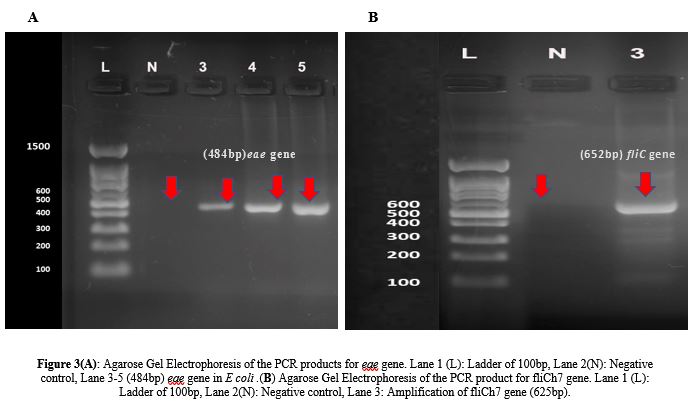
Microbial pathogens may be introduced into surface water sources through agricultural runoff, sewage discharge, or stormwater, and such contamination poses a significant threat to public health. Escherichia coli is a bacterial species that inhabits several environments, including the gastrointestinal tract of humans and warm-blooded animals. E. coli, especially the O157:H7 serotype, is an important indicator species for fecal contamination and possible pathogenicity. The objective of this study was to recover E. coli O157:H7 from the Great Zab River in Erbil and to investigate its virulence factors and the susceptibility of isolates to silver nanoparticles (AgNPs). 150 water samples, from different sources, were bacteriologically analyzed using Sorbitol MacConkey agar. The presumptive isolates were identified by means of biochemical tests and the VITEK 2 system. Three (2%) E. coli O157:H7 were isolated from the samples. Sensitivity of isolates to various AgNP concentrations was demonstrated by antimicrobial assays. One isolate was confirmed by sequencing 16S rRNA gene. PCR detected the presence of the eae gene in all isolates, the absence of shiga toxins, and in one isolate, the fliC gene was observed. These results demonstrate the pathogenic E. coli O157:H7 in the river and the potential application of AgNPs as an antimicrobial in such water bodies.
Full text article
References
Abdelghany, T. M., Al-Rajhi, A. M., Al Abboud, M. A., Alawlaqi, M. M., Ganash Magdah, A., Helmy, E. A., & Mabrouk, A. S. (2018). Recent advances in green synthesis of silver nanoparti cles and their applications: about future directions. A review. BioNanoScience, 8, 5–16. DOI:https://doi.org/10.1007/s12668 017-0413-3
Abou El-Nour, K. M., Eftaiha, A. A., Al-Warthan, A., & Am mar, R. A. (2010). Synthesis and applications of silver nanoparticles. Arabian Journal of Chemistry, 3(3), 135–140. DOI:https://doi.org/10.1016/j.arabjc.2010.04.008
Alwash, M. S., & Al-Rafyai, H. M. (2019). Antibiotic resistance patterns of diverse Escherichia coli phyloge netic groups isolated from the Al-Hillah River in Babylon Province, Iraq. The Scientific World Journal, 2019, 5927059. DOI:https://doi.org/10.1155/2019/5927059
Amézquita-López, B. A., Soto-Beltrán, M., Lee, B. G., Bon Haro, E. F., Lugo-Melchor, O. Y., & Quiñones, B. (2024). Virulence and antimicrobial resistance profiles of Shiga toxin-producing Escherichia coli from river water and farm animal feces near an agricultural region in north western Mexico. Microbiology Research, 15(1), 385–403. DOI:https://doi.org/10.3390/microbiolres15010026
Basavaraju, M., & Gunashree, B. (2022). Escherichia coli: An Overview of Main Characteristics. In IntechOpen eBooks. DOI:https://doi.org/10.5772/intechopen.105508
Beata, S., Michał, T., Mateusz, O., Urszula, W., Choroszy, M., Andrzej, T., & Piotr, D. (2021). Norepinephrine af fects the interaction of adherent-invasive Escherichia coli with intestinal epithelial cells. Virulence, 12(1), 630–637. DOI:https://doi.org/10.1080/21505594.2021.1882780
Beneduce, L., Spano, G., Nabi, A. Q., Lamacchia, F., Massa, S., Aouni, R., & Hamama, A. (2008). Occurrence and characteri zation of Escherichia coli O157 and other serotypes in raw meat products in Morocco. Journal of food protection, 71(10), 2082 2086. DOI:https://doi.org/10.4315/0362-028X-71.10.2082
Bisi-Johnson, M. A., Adedeji, A. A., Sulaiman, A. A., Adefisoye, M. A., & Okoh, A. I. (2023). Isolation and genotypic characteriza tion of extended-spectrum beta-lactamase-producing Escherichia coli O157: H7 andAeromonashydrophila from selected freshwa ter sources in Southwest Nigeria. Scientific reports, 13(1), 10746. DOI:https://doi.org/10.1038/s41598-023-38014-y
Chigor, V. N., Umoh, V. J., & Smith, S. I. (2010). Occurrence of Escherichia coli O157 in a river used for fresh produce ir rigation in Nigeria. African Journal of Biotechnology, 9(2). DOI:https://doi.org/10.5897/AJB09.149
Dankovich, T. A., & Gray, D. G. (2011). Bactericidal paper im pregnated with silver nanoparticles for point-of-use water treat ment. Environmental science & technology, 45(5), 1992–1998. DOI:https://doi.org/10.1021/es103302t
Dankovich, T. A., & Gray, D. G. (2011). Bactericidal paper im pregnated with silver nanoparticles for point-of-use water treat ment. Environmental science & technology, 45(5), 1992–1998. DOI:https://doi.org/10.1021/es103302t
El-Leithy, M., El-Shatoury, E. H., El-Senousy, W., Abou-Zeid, M., & El-Taweel, G. E. (2012). Detection of six E. coli O157 virulence genes in water samples using multiplex PCR. Egypt. J. Microbiol, 47, 171–188. DOI:https://doi.org/10.21608/ejm.2012.259
Erjavec, M. S. (2019). The Universe of Escherichia coli. BoD Books on Demand.
Fiorati, A., Bellingeri, A., Punta, C., Corsi, I., & Ven ditti, I. (2020). Silver nanoparticles for water pollu tion monitoring and treatments: ecosafety challenge and cellulose-based hybrids solution. Polymers, 12(8), 1635. DOI:https://doi.org/10.3390/polym12081635
Fouda, A., Abdel-Maksoud, G., Abdel-Rahman, M. A., Salem, S. S., Hassan, S. E. D., & El-Sadany, M. A. H. (2019). Eco-friendly approach utilizing green synthesized nanopar ticles for paper conservation against microbes involved in biodeterioration of archaeological manuscript. Interna tional Biodeterioration & Biodegradation, 142, 160–169. DOI:https://doi.org/10.1016/j.ibiod.2019.05.012
Gambushe, S. M., Zishiri, O. T., & Zowalaty, M. E. E. (2022). Review of Escherichia coli O157:H7 Prevalence, Pathogenic ity, Heavy Metal and Antimicrobial Resistance, African Per spective. Infection and Drug Resistance, 15, 4645–4673. DOI:https://doi.org/10.2147/idr.s365269
Garrine, M., Matambisso, G., Nobela, N., Vubil, D., Massora, S., Acácio, S., ... & Mandomando, I. (2020). Low fre quency ofenterohemorrhagic, enteroinvasive and diffusely adher ent Escherichia coli in children under 5 years in rural Mozam bique: a case-control study. BMC Infectious Diseases, 20, 1–6. DOI:https://doi.org/10.1186/s12879-020-05380-1
Hamner, S., Broadaway, S. C., Mishra, V. B., Tripathi, A., Mishra, R. K., Pulcini, E., ... & Ford, T. E. (2007). Isolation of po tentially pathogenic Escherichia coli O157: H7 from the Ganges River. Applied and environmental microbiology, 73(7), 2369 2372. DOI:https://doi.org/10.1128/AEM.00141-07
Hasan, H. K., Yassin, N. A., & Eassa, S. H. (2020). Bac teriological and Molecular Characterization of Diarrheagenic Escherichia Coli Pathotypes From Children in Duhok City, Iraq. Science Journal of University of Zakho, 8(2), 52–57. DOI:https://doi.org/10.25271/sjuoz.2020.8.1.702
Hessain, A. M., Al-Arfaj, A. A., Zakri, A. M., El-Jakee, J. K., Al Zogibi, O. G., Hemeg, H. A., & Ibrahim, I. M. (2015). Molecu lar characterization of Escherichia coli O157: H7 recovered from meat and meat products relevant to human health inRiyadh, Saudi Arabia. Saudi Journal of Biological Sciences, 22(6), 725–729. DOI:https://doi.org/10.1016/j.sjbs.2015.06.009
Hua, Y., Bai, X., Zhang, J., Jernberg, C., Chromek, M., Hans son, S., ... & Matussek, A. (2020). Molecular characteristics of eae-positive clinical Shiga toxin-producing Escherichia coli in Sweden. Emerging microbes & infections, 9(1), 2562–2570. DOI:https://doi.org/10.6084/m9.figshare.13359562
Kadhim, F. A., & Kareem, I. Q. A. (2021). MOLEC ULAR IDENTIFICATION OF ESCHERICHIA COLI SEROTYPE O157: H7 FROM HUMANS AND CHICK ENS IN IRAQ. Plant Archives, 21(1), 1183–1190. DOI: https://doi.org/10.51470/PLANTARCHIVES.2021.v21.S1.186
Korajkic, A., McMinn, B. R., & Harwood, V. J. (2018). Re lationships between microbial indicators and pathogens in recreational water settings. International Journal of En vironmental Research and Public Health, 15(12), 2842. DOI:https://doi.org/10.3390/ijerph15122842
Lane, D.(1991). 16S/23SrRNAsequencing. Nucleicacidtechniques in bacterial systematics.
Loukiadis, E., Kérourédan, M., Beutin, L., Oswald, E., & Brugère, H. (2006). Characterization of Shiga Toxin Gene ( stx )-Positive and Intimin Gene ( eae )-Positive Escherichia coli Isolates from Wastewater of Slaughterhouses in France. Applied and Environmental Microbiology, 72(5), 3245–3251. DOI:https://doi.org/10.1128/aem.72.5.3245-3251.2006
Lu, J., Shen, C., Zhou, Z., Zhang, Y., Wang, J., Liang, Y., ... & Shao, J. (2024). A calibration-free, non-invasive, and accu rate total viable count detection method based on tunable diode laser absorption spectroscopy combined with most probable num ber counting. Optics and Lasers in Engineering, 173, 107899. DOI:https://doi.org/10.1016/j.optlaseng.2023.107899
Lu, Y., Wang, R., Zhang, Y., Su, H., Wang, P., Jenkins, A., ... & Squire, G. (2015). Ecosystem health towards sus tainability. Ecosystem Health and Sustainability, 1(1), 1–15. DOI:https://doi.org/10.1890/ehs14-0013.1
Menéndez-Serra, M., Triadó-Margarit, X., Castañeda, C., Her rero, J., & Casamayor, E. O. (2019). Microbial com position, potential functional roles and genetic novelty in gypsum-rich and hypersaline soils of Monegros and Gallocanta (Spain). Science of the Total Environment, 650, 343–353. DOI:https://doi.org/10.1016/j.scitotenv.2018.09.050
Olowe, B., & Arogbodo, J. (2022). Molecular identifi cation of virulence and antibiotic-resistant gene in Es cherichia coli O157 and non-O157 recovered from water samples. Microbes and Infectious Diseases, 3(2), 348–359. DOI:https://doi.org/10.21608/mid.2021.74664.1148
Oluwarinde, B. O., Ajose, D. J., Abolarinwa, T. O., Montso, P. K., DuPreez, I., Njom, H. A., & Ateba, C. N. (2023). Safety properties of Escherichia coli O157:H7 specific bacterio phages: recent advances for food safety. Foods, 12, p.3989. DOI:https://doi.org/10.3390/foods12213989
Oves, M., Aslam,M.,Rauf,M.A.,Qayyum,S.,Qari,H.A.,Khan,M. S., ... & Ismail, I. M. (2018). Antimicrobial and anticancer activ ities of silver nanoparticles synthesized from the root hair extract of Phoenix dactylifera. Materials Science and Engineering: C, 89, 429–443. DOI:https://doi.org/10.1016/j.msec.2018.03.035
Paletta, A. C., Castro, V. S., & Conte-Junior, C. A. (2020). Shiga toxin-producing and enteroaggregative Escherichia coli in ani mal, foods, and humans: pathogenicity mechanisms, detection methods, and epidemiology. Current microbiology, 77, 612–620. DOI:https://doi.org/10.1007/s00284-019-01842-1
Peterson, E., & Kaur, P. (2018). Antibiotic resistance mech anisms in bacteria: relationships between resistance deter minants of antibiotic producers, environmental bacteria, and clinical pathogens. Frontiers in microbiology, 9, 2928. DOI:https://doi.org/10.3389/fmicb.2018.02928
Razmi, N., Hasanzadeh, M., Willander, M., & Nur, O. (2022). Elec trochemical genosensor based on gold nanostars for the detection of Escherichia coli O157: H7 DNA. Analytical Methods, 14(16), 1562–1570. DOI:https://doi.org/10.1039/d2ay00056c
Saeed, A. Y., & Ibrahim, K. S. (2013). Detection of Enterohe morrhagic Escherichia Coli O157 in Sheep and Goats Using Fluorogenic and Chromogenic Culture Media. Science Jour nal of University of Zakho, 1(1), 115–119. Retrieved from https://sjuoz.uoz.edu.krd/index.php/sjuoz/article/view/53
Samuel, M. S., Jose, S., Selvarajan, E., Mathimani, T., & Pugazhendhi, A. (2020). Biosynthesized silver nanopar ticles using Bacillus amyloliquefaciens: Application for cytotoxicity effect on A549 cell line and photocat alytic degradation of p-nitrophenol. Journal of Photo chemistry and Photobiology B: Biology, 202, 111642. DOI:https://doi.org/10.1016/j.jphotobiol.2019.111642
Sharef, A. J., & Dara, R. N. (2021). Greater zab river Basin planning (2050). Iraqi Journal of Agricultural Sciences, 52(5), 1150–1162. DOI:https://doi.org/10.36103/ijas.v52i5.1453
Sthapit, N., Malla, B., Tandukar, S., Ghaju Shrestha, R., Thakali, O., Sherchand, J. B., ... & Kazama, F. (2022). Occurrence and reduction of Shiga toxin-producing Escherichia coli in Wastew aters in the Kathmandu Valley, Nepal. Water, 14(14), 2224. DOI:https://doi.org/10.3390/w14142224
Subramanian, S., & Kearns, D. B. (2019). Functional regulators of bacterial flagella. Annual Review of Microbiology, 73(1), 225 246. DOI:https://doi.org/10.1146/annurev-micro-020518-115725
Urnukhsaikhan, E., Bold, B. E., Gunbileg, A., Sukhbaatar, N., & Mishig-Ochir, T. (2021). Antibacterial activity and characteristics of silver nanoparticles biosynthesized from Carduus crispus. Scientific reports, 11(1), 21047. DOI:https://doi.org/10.1038/s41598-021-00612-w
Wang, X., Lee, S. Y., Akter, S., & Huq, M. A. (2022). Probiotic-mediated biosynthesis of silver nanoparticles and their antibacterial applications against pathogenic strains of Escherichia coli O157: H7. Polymers, 14(9), 1834. DOI:https://doi.org/10.3390/polym1409183
Wolfson, E. B., Elvidge, J., Tahoun, A., Gillespie, T., Mantell, J., McAteer, S. P., Rossez, Y., Paxton, E., Lane, F., Shaw, D. J., Gill, A. C., Stevens, J., Verkade, P., Blocker, A., Mahajan, A., & Gally, D. L. (2020). The interaction of Escherichia coli O157:H7 and Salmonella Typhimurium flagella with host cell membranes and cytoskeletal components. Microbiology, 166(10), 947–965. DOI:https://doi.org/10.1099/mic.0.000959
Yang, F., Yang, L., Chang, Z., Chang, L., & Yang, B. (2018). Regulation of virulence and motility by ac etate in enteropathogenic Escherichia coli. Interna tional Journal of Medical Microbiology, 308(7), 840–847. DOI:https://doi.org/10.1016/j.ijmm.2018.07.010
Yang, X., Sun, H., Fan, R., Fu, S., Zhang, J., Matussek, A., & Bai, X. (2020). Genetic diversity of the intimin gene (eae) in non-O157 Shiga toxin-producing Escherichia coli strains in China. Scien tific Reports, 10, 3275. DOI:https://doi.org/10.1038/s41598-020 60225-w
Zhang, Y., Liao, Y., Salvador, A., Sun, X., & Wu, V. C. H. (2020). Investigating the Whole-Genome Sequence of a New Locus of Enterocyte Effacement-Positive Shiga Toxin Producing Escherichia coli O157:H7 Strain Isolated from River Water. Microbiology Resource Announcements, 9(12). DOI:https://doi.org/10.1128/mra.00112-20
Authors
Copyright (c) 2026 Aras Jamal Abdulqader and Bahaddin Salih Hamid

This work is licensed under a Creative Commons Attribution-NonCommercial-ShareAlike 4.0 International License.
Authors who publish with this journal agree to the following terms:
- Authors retain copyright and grant the journal right of first publication with the work simultaneously licensed under a Creative Commons Attribution License [CC BY-NC-SA 4.0] that allows others to share the work with an acknowledgment of the work's authorship and initial publication in this journal.
- Authors are able to enter into separate, additional contractual arrangements for the non-exclusive distribution of the journal's published version of the work, with an acknowledgment of its initial publication in this journal.
- Authors are permitted and encouraged to post their work online.