
Growth, Antioxidant Defense, and Immune Response in <i>Labeo rohita</i> Fingerlings with the Dietary Vitamin C Supplementation

Article Sidebar
-
Labeo rohita, Vitamin C, Growth performance, Oxidative stress, Immune response
Abstract
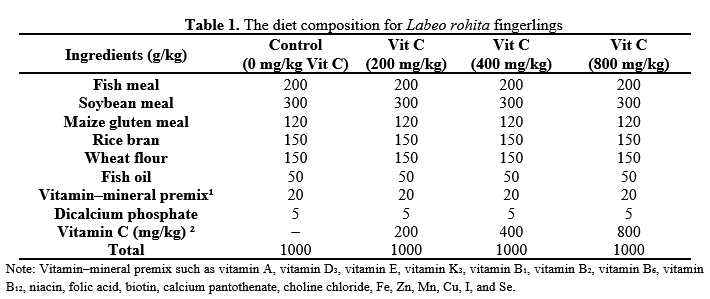
The study was designed to investigate the vitamin C supplementation effect on growth, oxidative stress, and immune response of Labeo rohita. Four diets 0, 200, 400, and 800 mg/kg was designed, 480 fingerlings with the initial weight 6.11 ± 0.08 g in triplicate groups were randomly distributed into 12 fiberglass tanks for 60 days. Growth results showed that final weight (13.87 ± 0.23–19.83 ± 0.34 g), weight gain (152.6 ± 2.7–251.1 ± 3.5%), and specific growth rate (1.91 ± 0.06–2.52 ± 0.03%/day) increased significantly (p < 0.05) with increasing dietary vitamin C levels, while feed conversion ratio (1.81 ± 0.04–1.29 ± 0.04) decreased (p = 0.006), indicating improved feed utilization.
Survival rates were 91.1 ± 2.4% in the control, whereas they reached 98.4 ± 1.4% in the 800 mg/kg group. Antioxidant enzyme showed a significant (p < 0.01) enhancement. Superoxide dismutase (SOD) and catalase (CAT) activities increased from 25.6 ± 1.3 to 36.1 ± 1.3 U/mg protein and 12.4 ± 0.7 to 20.1 ± 0.5 U/mg protein. The malondialdehyde (MDA) levels reduced significantly (p = 0.005), while glutathione (GSH) concentration increased significantly (p = 0.007) from 3.10 ± 0.13 to 4.41 ± 0.13 µmol/g tissue. Immune response parameters were also positively affected by dietary vitamin C. Lysozyme activity increased significantly (p = 0.008) from 15.4 ± 0.3 to 23.4 ± 0.6 U/mL, respiratory burst activity improved from 0.178 ± 0.006 to 0.261 ± 0.006 OD₆₃₀ nm, and phagocytic activity rose from 28.3 ± 1.4 to 41.4 ± 1.4%. Similarly, nitric oxide production increased from 4.13 ± 0.28 to 6.86 ± 0.26 µmol/L. Total protein, albumin, and globulin were also significantly raised (p < 0.05). The study concluded that dietary vitamin C can be used to increase growth, support antioxidant defense, and improve immune responses in L. rohita
Full text article
References
Abalaka, S. E., Oyelowo, F. O., Akande, M. G., Tenuche, O. Z., Sani, N. A., Adeyemo, B. T., & Ejeh, S. A. (2021). Effects of Moringa oleifera leaves extract, vitamin C, and taurine co-exposures on calcium and metallothionein levels, oxidative stress, and gill histopathological changes in Clarias gariepinus exposed to sub-lethal cadmium. Environmental Science and Pollution Research, 28(37), 52258-52271.DOI: 10.1007/s11356-021-14426-z
Abdelwahab, A. M., El-Bahr, S. M., & Al-Khamees, S. (2020). Influence of dietary garlic (Allium sativum) and/or ascorbic acid on performance, feed utilization, body composition and hemato-biochemical parameters of juvenile Asian Sea Bass (Lates calcarifer). Animals, 10(12), 2396. DOI: 10.3390/ani10122396
Abdul-Qadir, A. M., Aliyu-Paiko, M., Mohammed, A. K., & Ndejiko, M. J. (2024). Biofloc technology as a sustainable alternative for managing aquaculture wastewater. Journal of Biochemistry, Microbiology and Biotechnology, 12(1), 44-53. DOI: 10.1111/lre.12449
Alberts, A., Moldoveanu, E. T., Niculescu, A. G., & Grumezescu, A. M. (2025). Vitamin C: a comprehensive review of its role in health, disease prevention, and therapeutic potential. Molecules, 30(3), 748. DOI: 10.3390/molecules30030748
Awuchi, C. G., Igwe, V. S., Amagwula, I. O., & Echeta, C. K. (2020). Health benefits of micronutrients (vitamins and minerals) and their associated deficiency diseases: A systematic review. International Journal of Food Sciences, 3(1), 1-32. DOI: 10.47604/ijf.1024
Biswas, P., Dellanoce, C., Vezzoli, A., Mrakic-Sposta, S., Malnati, M., Beretta, A., & Accinni, R. (2020). Antioxidant activity with increased endogenous levels of vitamin C, E and A following dietary supplementation with a combination of glutathione and resveratrol precursors. Nutrients, 12(11), 3224. DOI: 10.3390/nu12113224
Daniel, N., Muralidhar, A. P., Srivastava, P. P., Jain, K. K., Prasad, K. P., & Ranjan, A. (2021). Effect of vitamin C on immune and stress responses in striped catfish, Pangasianodon hypophthalmus juveniles under pre‐and post‐challenge with Aeromonas hydrophila. Aquaculture Research, 52(12), 6444-6452. DOI: 10.1111/are.15509
El-Gendy, K. S., Aly, N. M., Mahmoud, F. H., Kenawy, A., & El-Sebae, A. K. H. (2010). The role of vitamin C as antioxidant in protection of oxidative stress induced by imidacloprid. Food and chemical Toxicology, 48(1), 215-221. DOI: 10.1016/j.fct.2009.10.003
Fasil, D. M., Hamdi, H., Al-Barty, A., Zaid, A. A., Parashar, S. K. S., & Das, B. (2021). Selenium and zinc oxide multinutrient supplementation enhanced growth performance in zebra fish by modulating oxidative stress and growth-related gene expression. Frontiers in Bioengineering and Biotechnology, 9, 721717. DOI: 10.3389/fbioe.2021.721717
Fazal, R. M., Fatima, A., Al Sulivany, B. S., Hussain, R., Hassan, A., Shahid, A., & Owais, M. (2025). Enhancing Growth Performance, Antioxidant Defense, And Immune Response in Striped Catfish (Pangasius hypophthalmus) Through Dietary Supplementation with Aloe Vera: A Sustainable Aquaculture Approach. Science Journal of University of Zakho, 13(4), 510-518. DOI: 10.25271/sjuoz.2025.13.4.1691
Firouzi, S., Pahlavani, N., Navashenaq, J. G., Clayton, Z. S., Beigmohammadi, M. T., & Malekahmadi, M. (2022). The effect of Vitamin C and Zn supplementation on the immune system and clinical outcomes in COVID-19 patients. Clinical nutrition open science, 44, 144-154. DOI: 10.1016/j.nutos.2022.06.006
Gao, X., Wei, M., Ma, D., Yang, X., Zhang, Y., Zhou, X., & Yang, W. (2021). Engineering of a hollow‐structured Cu2− XS nano‐homojunction platform for near infrared‐triggered infected wound healing and cancer therapy. Advanced Functional Materials, 31(52), 2106700. DOI: 10.1002/adfm.202106700
Gupta, A., Gupta, S. K., Priyam, M., Siddik, M. A., Kumar, N., Mishra, P. K., & Pattanayak, A. (2021). Immunomodulation by dietary supplements: A preventive health strategy for sustainable aquaculture of tropical freshwater fish, Labeo rohita (Hamilton, 1822). Reviews in Aquaculture, 13(4), 2364-2394. DOI:10.1111/raq.12581
Hossain, M. A., Hossain, M. A., Haque, M. A., Mondol, M. M. R., Harun-Ur-Rashid, M., & Das, S. K. (2022). Determination of suitable stocking density for good aquaculture practice-based carp fattening in ponds under drought-prone areas of Bangladesh. Aquaculture, 547, 737485. DOI:10.1016/j.aquaculture.2021.737485
Ibraheem, M., Mohamed, A. M. & Albassam. N. (2017). The Bacteria contamination of red local meat and white imported meat in Samaraa and Al-Dour districts. Annals of Agricultural Science, Moshtohor, 55(4), 831-836. DOI: 10.21608/assjm.2017.57017
Ibrahim, R. E., Ahmed, S. A., Amer, S. A., Al-Gabri, N. A., Ahmed, A. I., Abdel-Warith, A. W. A., & Metwally, A. E. (2020). Influence of vitamin C feed supplementation on the growth, antioxidant activity, immune status, tissue histomorphology, and disease resistance in Nile tilapia, Oreochromis niloticus. Aquaculture Reports, 18, 100545. DOI: 10.1016/j.aqrep.2020.100545
Ibrahim, R. E., Amer, S. A., Farroh, K. Y., Al-Gabri, N. A., Ahmed, A. I., El-Araby, D. A., & Ahmed, S. A. (2021). The effects of chitosan-vitamin C nanocomposite supplementation on the growth performance, antioxidant status, immune response, and disease resistance of Nile tilapia (Oreochromis niloticus) fingerlings. Aquaculture, 534, 736269. DOI: 10.1016/j.aquaculture.2020.736269
Ilhan, N., Kamanli, A., Ozmerdivenli, R., & Ilhan, N. (2004). Variable effects of exercise intensity on reduced glutathione, thiobarbituric acid reactive substance levels, and glucose concentration. Archives of medical research, 35(4), 294-300. DOI: 10.1016/j.arcmed.2004.03.006
Irshath, A. A., Rajan, A. P., Vimal, S., Prabhakaran, V. S., & Ganesan, R. (2023). Bacterial pathogenesis in various fish diseases: recent advances and specific challenges in vaccine development. Vaccines, 11(2), 470. DOI: 10.3390/vaccines11020470
Jiménez-Fernández, E., Ponce, M., Rodríguez-Rúa, A., Manchado, M., & Fernández-Díaz, C. (2018). Assessing the role of vitamin C and iron in early larvae stages of Solea senegalensis fed enriched Artemia. Aquaculture, 488, 145-154. DOI: 10.1016/j.aquaculture.2018.01.021
Katsoulos, P. D., Athanasiou, L. V., Karatzia, M. A., Giadinis, N., Karatzias, H., Boscos, C., & Polizopoulou, Z. S. (2017). Comparison of biuret and refractometry methods for the serum total proteins measurement in ruminants. Veterinary Clinical Pathology, 46(4), 620-624. DOI: 10.1111/vcp.12532
Liua, B., Wana, J., Gea, X., Xiea, J., Zhoub, Q., Miaob, L., & Panb, L. (2016). Effects of dietary Vitamin C on the physiological responses and disease resistance to pH stress and Aeromonas hydrophila infection of Megalobrama amblycephala. Turkish Journal of Fisheries and Aquatic Sciences, 16(2), 421-433. DOI: 10.4194/1303-2712-v16_2_22
Magouz, F. I., Dawood, M. A., Salem, M. F., El-Ghandour, M., Van Doan, H., & Mohamed, A. A. (2020). The role of a digestive enhancer in improving the growth performance, digestive enzymes activity, and health condition of Nile tilapia (Oreochromis niloticus) reared under suboptimal temperature. Aquaculture, 526, 735388. DOI:10.1016/j.aquaculture.2020.735388
Misra, C. K., Das, B. K., Mukherjee, S. C., & Pradhan, J. (2007). Effects of dietary vitamin C on immunity, growth and survival of Indian major carp Labeo rohita, fingerlings. Aquaculture Nutrition, 13(1), 35-44. DOI: 10.1111/j.1365-2095.2007.00451.x
Mohamad Hassan, S., Salah, M., Albassam, N. H., Mdloul, N. S., Muhaimeed, A. R. and Sulaiman, M. A. (2025). Using the Diverse Vegetables as a Filtration plants in Aquaculture Intensive System. Tikrit Journal for Agricultural Sciences, 25(1), 1-16. DOI: 10.25130/tjas.25.1.1
Moore, J. C., DeVries, J. W., Lipp, M., Griffiths, J. C., & Abernethy, D. R. (2010). Total protein methods and their potential utility to reduce the risk of food protein adulteration. Comprehensive reviews in food science and food safety, 9(4), 330-357. DOI: 10.1111/j.1541-4337.2010.00114.x
Namiq, K., Albassam, N. H., & Wahab, N. K. (2025). Assessment of Pesticide Residues in Fish Tissues and Water at Various Time of the Year. Diyala Agricultural Sciences Journal, 17(1),178–193. DOI: 10.52951/dasj.25170114
Narra, M. R., Rajender, K., Reddy, R. R., Rao, J. V., & Begum, G. (2015). The role of vitamin C as antioxidant in protection of biochemical and haematological stress induced by chlorpyrifos in freshwater fish Clarias batrachus. Chemosphere, 132, 172-178. DOI: 10.1016/j.chemosphere.2015.03.006
Pavlou, S., Wang, L., Xu, H., & Chen, M. (2017). Higher phagocytic activity of thioglycollate-elicited peritoneal macrophages is related to metabolic status of the cells. Journal of inflammation, 14(1), 4.DOI: 10.1186/s12950-017-0151-x
Privat, C., Lantoine, F., Bedioui, F., Van Brussel, E. M., Devynck, J., & Devynck, M. A. (1997). Nitric oxide production by endothelial cells: comparison of three methods of quantification. Life Sciences, 61(12), 1193-1202. DOI: 10.1016/S0024-3205(97)00661-9
Rothe, G., Emmendorffer, A., Oser, A., Roesler, J., & Valet, G. (1991). Flow cytometric measurement of the respiratory burst activity of phagocytes using dihydrorhodamine 123. J Immunol Methods, 138(1), 133-5. DOI: 10.1016/0022-1759(91)90074-p
Sherif, A. H., Khalil, R. H., Talaat, T. S., Baromh, M. Z., & Elnagar, M. A. (2024). Dietary nanocomposite of vitamin C and vitamin E enhanced the performance of Nile tilapia. Scientific Reports, 14(1), 15648. DOI: 10.1038/s41598-024-65507-1
Singh, P., Kesharwani, R. K., & Keservani, R. K. (2017). Antioxidants and vitamins: Roles in cellular function and metabolism. In Sustained energy for enhanced human functions and activity 385-407. Academic Press.
Soldado, D., Bessa, R. J., & Jerónimo, E. (2021). Condensed tannins as antioxidants in ruminants Effectiveness and action mechanisms to improve animal antioxidant status and oxidative stability of products. Animals, 11(11), 3243. DOI: 10.3390/ani11113243
Surai, P. F., Kochish, I. I., Fisinin, V. I., & Kidd, M. T. (2019). Antioxidant defence systems and oxidative stress in poultry biology: An update. Antioxidants, 8(7), 235. DOI: 10.3390/antiox8070235
Taalab, H. A., Mohammady, E. Y., Hassan, T. M., Abdella, M. M., & Hassaan, M. S. (2022). β‐Carotene of Arthrospira platensis versus vitamin C and vitamin E as a feed supplement: Effects on growth, haemato‐biochemical, immune‐oxidative stress and related gene expression of Nile tilapia fingerlings. Aquaculture Research, 53(13), 4832-4846. DOI: 10.1111/are.15977
Tang, Z., Xie, S., Cui, Y., Zhan, W., Deng, Y., Peng, H., ... & Zhou, Q. (2024). Vitamin C as a functional enhancer in the non-specific immune defense, antioxidant capacity and resistance to low-temperature stress of juvenile mud crab, Scylla paramamosain. Fish & Shellfish Immunology, 153, 109834.DOI: 10.1016/j.fsi.2024.109834
Xu, C. M., Yu, H. R., Li, L. Y., Li, M., Qiu, X. Y., Fan, X. Q. & Shan, L. L. (2022). Effects of dietary vitamin C on the growth performance, biochemical parameters, and antioxidant activity of coho salmon Oncorhynchus kisutch (Walbaum, 1792) Postsmolts. Aquaculture nutrition, 2022(1), 6866578. DOI: 10.1155/2022/6866578
Xue, M., Wu, Y., Hong, Y., Meng, Y., Xu, C., Jiang, N. & Zhou, Y. (2022). Effects of dietary Bacillus amyloliquefaciens on the growth, immune responses, intestinal microbiota composition and disease resistance of yellow catfish, Pelteobagrus fulvidraco. Frontiers in Cellular and Infection Microbiology, 12, 1047351. DOI:10.3389/fcimb.2022.1047351
Zhang, A., Stacey, H. D., D’Agostino, M. R., Tugg, Y., Marzok, A., & Miller, M. S. (2023). Beyond neutralization: Fc-dependent antibody effector functions in SARS-CoV-2 infection. Nature Reviews Immunology, 23(6), 381-396. DOI: 10.1038/s41577-022-00813-1
Authors
Copyright (c) 2026 Zainab Asghar, Nuha Hameed Albasssam, Milat Hussain Mustafa, Hifza Afzaal, Zeliha Selamoglu, Arooj Fatima, Danish kamal, Rashid Hussain.

This work is licensed under a Creative Commons Attribution-NonCommercial-ShareAlike 4.0 International License.
Authors who publish with this journal agree to the following terms:
- Authors retain copyright and grant the journal right of first publication with the work simultaneously licensed under a Creative Commons Attribution License [CC BY-NC-SA 4.0] that allows others to share the work with an acknowledgment of the work's authorship and initial publication in this journal.
- Authors are able to enter into separate, additional contractual arrangements for the non-exclusive distribution of the journal's published version of the work, with an acknowledgment of its initial publication in this journal.
- Authors are permitted and encouraged to post their work online.