
PREVALENCE OF Theileria annulata AND THE FIRST REPORT OF Theileria sinensis IN CATTLE FROM ERBIL PROVINCE, IRAQ

Article Sidebar
-
Molecular, Epidemiology, Theileria annulata, Theileria sinensis, Cattle
Abstract
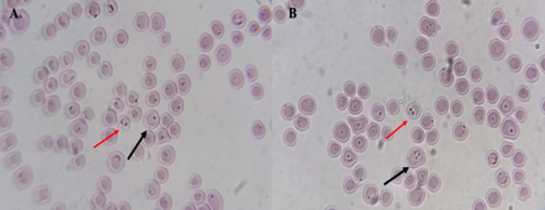
Bovine theileriosis is a significant tick-borne protozoan disease of cattle, primarily caused by species of the genus Theileria. This study investigated the prevalence of bovine theileriosis in cattle using both microscopic examination and conventional PCR (c-PCR). Microscopic analysis of Giemsa-stained blood smears identified an infection rate of 51/236 (21.6%), while c-PCR revealed a significantly higher prevalence of 106/236 (44.9%). Theileria species were characterized morphologically and confirmed via molecular methods. PCR analysis identified Theileria annulata and Theileria sinensis as the causative agents, with T. annulata showing the highest rate of single infections 89/106 (84%) compared to T. sinensis 17/106 (16%). Mixed infections were detected in 13/106 (12.3%) of cases. Age, sex, breed, housing conditions, acaricide use, and tick infestation were identified as key risk factors influencing infection rates. Management and tick-related factors significantly influenced Theileria prevalence, with higher infection rates observed in cattle with tick infestation 54/102 (52.9%), irregular or no acaricide use 58/115 (50.4%) and 27/47 (58.7%) respectively, non-cemented floors 72/125 (57.6%), and tick presence in barns 64/127 (50.4%). Phylogenetic analysis demonstrated genetic similarities between the identified T. annulata and T. sinensis sequences and strains reported from other geographical regions. Notably, this study provides the first report of T. sinensis in Iraq, highlighting its emergence and underscoring the need for enhanced surveillance and control measures against Theileria infections in the country. The high prevalence of the disease underscores the urgent need for enhanced surveillance, effective tick control measures, and the implementation of integrated strategies to mitigate the impact of bovine theileriosis on cattle health and productivity.
Full text article
References
Aktas, M., Altay, K., & Dumanli, N. (2006). A molecular survey of bovine Theileria parasites among apparently healthy cattle and with a note on the distribution of ticks in eastern Turkey. Veterinary parasitology, 138(3-4), 179-185. https://doi.org/10.1016/j.vetpar.2006.01.052
Al-Saeed, A. T., & AL-Badrani, M. A. (2014). Study of the parasites of the local chickens (Gallus gallus domisticus) in Duhok province, Kurdistan Region-Iraq. Science Journal of University of Zakho, 2(1), 18-23. https://doi.org/10.25271/2014.2.1.110
Albakri, H. S., Suleiman, E. G., & Al-Taee, A. F. (2024). Molecular identification of Theileria species in cattle in Mosul city. Iraqi Journal of Veterinary Sciences, 38(1), 183-189. https://doi.org/10.33899/ijvs.2023.141344.3112
Almería, S., Castella, J., Ferrer, D., Ortuno, A., Estrada-Peña, A., & Gutierrez, J. (2001). Bovine piroplasms in Minorca (Balearic Islands, Spain): a comparison of PCR-based and light microscopy detection. Veterinary parasitology, 99(3), 249-259. https://doi.org/10.1016/s0304-4017(01)00464-2
Aulakh, G., & Singla, L. (2006). Clinico-haematobiochemical observations on bovines naturally infected with Theileria annulata. Journal of Veterinary Parasitology, 20(1), 49-52. https://doi.org/10.1501/vetfak_0000001234
Aziz, K. J., & Al-Barwary, L. T. O. (2019). Epidemiological study of equine piroplasmosis (Theileria equi and Babesia caballi) by microscopic examination and competitive-ELISA in Erbil Province North-Iraq. Iranian journal of parasitology, 14(3), 404. https://doi.org/10.18502/ijpa.v14i3.1479
Bishop, R., Musoke, A., Skilton, R., Morzaria, S., Gardner, M., & Nene, V. (2008). Theileria: life cycle stages associated with the ixodid tick vector. In: Cambridge University Press. https://doi.org/10.1017/cbo9780511551802.015
d'Oliveira, C., Van Der Weide, M., Habela, M.A., Jacquiet, P. and Jongejan, F. (1995). Detection of Theileria annulata in blood samples of carrier cattle by PCR. Journal of Clinical Microbiology, 33(10), 2665-2669. https://doi.org/10.1128/jcm.33.10.2665-2669.1995
Edgar, R. C. (2004). MUSCLE: multiple sequence alignment with high accuracy and high throughput. Nucleic acids research, 32(5), 1792-1797. https://doi.org/10.1093/nar/gkh340
Gharbi, M., Darghouth, M. A., Elati, K., AL‐Hosary, A. A., Ayadi, O., Salih, D. A., . . . Hassan, S. M. (2020). Current status of tropical theileriosis in Northern Africa: A review of recent epidemiological investigations and implications for control. Transboundary and emerging diseases, 67, 8-25. https://doi.org/10.1111/tbed.13312
Ismael, S., & Omer, L. (2021). Molecular identification of new circulating Hyalomma asiaticum asiaticum from sheep and goats in Duhok Governorate, Iraq. https://doi.org/10.33899/ijvs.2020.126330.1298
Kamani, J., Vieira, T. S. W. J., da Costa Vieira, R. F., Shekaro, A., Nahum-Biala, Y., Olubade, T., . . . Shand, M. (2023). Molecular detection of Theileria annulata, Theileria mutans and Theileria velifera but no evidence of Theileria parva infected or vaccinated cattle in Nigeria despite extensive transboundary migrations. Veterinary Parasitology: Regional Studies and Reports, 41, 100887. https://doi.org/10.1016/j.vprsr.2023.100887
Kirvar, E., Ilhan, T., Katzer, F., Hooshmand-Rad, P., Zweygarth, E., Gerstenberg, C., Phipps, P. and Brown, C.G.D. (2000). Detection of Theileria annulata in cattle and vector ticks by PCR using the Tams1 gene sequences. Parasitology, 120(3), 245-254. https://doi.org/10.1017/S0031182099005466
Kozhabaev, M., Kuzerbaeva, A., Baizhanov, K., Tulemetova, S., & Nurkhodzhaev, N. (2023). Study of the dynamics of distribution, seasonality, and degree of infection with bovine theileriosis in the territory of Turkestan Region. https://doi.org/10.47278/journal.ijvs/2022.203
Lakew, B. T., Eastwood, S., & Walkden-Brown, S. W. (2023). Epidemiology and Transmission of Theileria orientalis in Australasia. Pathogens, 12(10). doi:10.3390/pathogens12101187 https://doi.org/10.3390/pathogens12101187
Larcombe, S. D., Capewell, P., Jensen, K., Weir, W., Kinnaird, J., Glass, E. J., & Shiels, B. R. (2022). Susceptibility to disease (tropical theileriosis) is associated with differential expression of host genes that possess motifs recognised by a pathogen DNA binding protein. PloS one, 17(1), e0262051. https://doi.org/10.1371/journal.pone.0262051
Li, Y., Galon, E. M., Guo, Q., Rizk, M. A., Moumouni, P. F. A., Liu, M., . . . Xuan, X. (2020). Molecular detection and identification of Babesia spp., Theileria spp., and Anaplasma spp. in sheep from border regions, northwestern China. Frontiers in Veterinary Science, 7, 630. https://doi.org/10.3389/fvets.2020.00630
Liu, A., Guan, G., Liu, Z., Liu, J., Leblanc, N., Li, Y., . . . Ren, Q. (2010). Detecting and differentiating Theileria sergenti and Theileria sinensis in cattle and yaks by PCR based on major piroplasm surface protein (MPSP). Experimental Parasitology, 126(4), 476-481. https://doi.org/10.1016/j.exppara.2010.05.024
Liu, Z., Hou, J., Bakheit, M. A., Salih, D. A., Luo, J., Yin, H., . . . Seitzer, U. (2008). Development of loop-mediated isothermal amplification (LAMP) assay for rapid diagnosis of ovine theileriosis in China. Parasitology research, 103, 1407-1412. https://doi.org/10.1007/s00436-008-1149-3
Ma, Q., Liu, J., Li, Z., Xiang, Q., Wang, J., Liu, A., . . . Luo, J. (2020). Clinical and pathological studies on cattle experimentally infected with Theileria annulata in China. Pathogens, 9(9), 727. https://doi.org/10.3390/pathogens9090727
McFadden, A., Rawdon, T., Meyer, J., Makin, J., Morley, C., Clough, R., . . . Geysen, D. (2011). An outbreak of haemolytic anaemia associated with infection of Theileria orientalis in naive cattle. New Zealand Veterinary Journal, 59(2), 79-85. https://doi.org/10.1080/00480169.2011.552857
Norouzi, M., Dayer, M. S., & Ghaffarifar, F. (2023). Molecular detection and characterisation of Theileria in hard ticks of small ruminants in Zarrin Dasht County, Southern Iran. Veterinary Medicine and Science, 9(1), 372-379. https://doi.org/10.1002/vms3.1027/v1/review3
Oakes, V. J., Yabsley, M. J., Schwartz, D., LeRoith, T., Bissett, C., Broaddus, C., . . . Brookhart, M. (2019). Theileria orientalis Ikeda genotype in cattle, Virginia, USA. Emerging Infectious Diseases, 25(9), 1653. https://doi.org/10.3201/eid2509.190088
Omer, O. H., El-Malik, K., Magzoub, M., Mahmoud, O., Haroun, E., Hawas, A., & Omar, H. (2003). Biochemical profiles in Friesian cattle naturally infected with Theileria annulata in Saudi Arabia. Veterinary research communications, 27, 15-25.
Ota, N., Mizuno, D., Kuboki, N., Igarashi, I., Nakamura, Y., Yamashina, H., . . . Hata, H. (2009). Epidemiological survey of Theileria orientalis infection in grazing cattle in the eastern part of Hokkaido, Japan. Journal of Veterinary Medical Science, 71(7), 937-944. https://doi.org/10.1292/jvms.71.937
Payne, R., Murray, D., Harding, S., Baird, D., & Soutar, D. (2009). GenStat for windows introduction. VSN International, Hemel Hempstead, 204.
Qin, G., Li, Y., Liu, J., Liu, Z., Yang, J., Zhang, L., . . . Yin, H. (2016). Molecular detection and characterization of Theileria infection in cattle and yaks from Tibet Plateau Region, China. Parasitology research, 115, 2647-2652. https://doi.org/10.1007/s00436-016-5011-8
Riaz, M., & Tasawar, Z. (2017). Identification of Theileria species (Theileria ovis and Theileria lestoquardi) by PCR in apparently healthy small ruminants in and around Multan, Southern Punjab, Pakistan.
Schnittger, L., Ganzinelli, S., Bhoora, R., Omondi, D., Nijhof, A. M., & Florin-Christensen, M. (2022). The Piroplasmida Babesia, Cytauxzoon, and Theileria in farm and companion animals: species compilation, molecular phylogeny, and evolutionary insights. Parasitology research, 121(5), 1207-1245. https://doi.org/10.1007/s00436-022-07424-8
Selim, A., Weir, W., & Khater, H. (2022). Prevalence and risk factors associated with tropical theileriosis in Egyptian dairy cattle. Veterinary world, 15(4), 919. https://doi.org/10.14202/vetworld.2022.919-924
Shahedi, A., Habibi, G., Fathi, S., Abdigoudarzi, M., Afshari, A., Bozorgi, S., & Chegini, M. R. (2022). Molecular identification of Theileria spp. in ruminants and ticks from southern littoral of Caspian Sea, Iran. Tropical Animal Health and Production, 54(3), 157. https://doi.org/10.1007/s11250-022-03156-0
Simuunza, M., Weir, W., Courcier, E., Tait, A., & Shiels, B. (2011). Epidemiological analysis of tick-borne diseases in Zambia. Veterinary parasitology, 175(3-4), 331-342. https://doi.org/10.1016/j.vetpar.2010.09.027
Tamura, K., Stecher, G., & Kumar, S. (2021). MEGA11: molecular evolutionary genetics analysis version 11. Molecular biology and evolution, 38(7), 3022-3027. https://doi.org/10.1093/molbev/msab120
Tuli, A., Singla, L. D., Sharma, A., Bal, M. S., Filia, G., & Kaur, P. (2015). Molecular epidemiology, risk factors and hematochemical alterations induced by Theileria annulata in bovines of Punjab (India). Acta parasitologica, 60(3), 378-390. https://doi.org/10.1515/ap-2015-0053
Valente, D., Gomes, J., Coelho, A. C., & Carolino, I. (2022). Genetic resistance of bovines to theileriosis. Animals, 12(21), 2903. https://doi.org/10.3390/ani12212903
Zajac, A. M., Conboy, G. A., Little, S. E., & Reichard, M. V. (2021). Veterinary clinical parasitology: John Wiley & Sons.
Zangana, I.K., & Naqid, I.A. (2011). Prevalence of piroplasmosis (Theileriosis and Babesiosis) among goats in Duhok Governorate. Al-Anbar J Vet Sci, 4(2), 50-7.
Zangana, I.K., Ali, B.A., & Naqid, I.A. (2013). Distribution of ectoparasites infested sheep and goats in Duhok province, north Iraq. Bas. J. Vet. Res, 12(1), 54-64.
Zeb, J., Shams, S., Din, I. U., Ayaz, S., Khan, A., Nasreen, N., . . . Senbill, H. (2020). Molecular epidemiology and associated risk factors of Anaplasma marginale and Theileria annulata in cattle from North-western Pakistan. Veterinary parasitology, 279, 109044. https://doi.org/10.1016/j.vetpar.2020.109044
Authors
Copyright (c) 2026 Musa Adil Wahab & Khalid Jabar Aziz

This work is licensed under a Creative Commons Attribution-NonCommercial-ShareAlike 4.0 International License.
Authors who publish with this journal agree to the following terms:
- Authors retain copyright and grant the journal right of first publication with the work simultaneously licensed under a Creative Commons Attribution License [CC BY-NC-SA 4.0] that allows others to share the work with an acknowledgment of the work's authorship and initial publication in this journal.
- Authors are able to enter into separate, additional contractual arrangements for the non-exclusive distribution of the journal's published version of the work, with an acknowledgment of its initial publication in this journal.
- Authors are permitted and encouraged to post their work online.