
A MORPHOLOGICAL STUDY OF SOME SPECIES OF THE GENUS Medicago L. (Fabaceae) IN KURDISTAN /IRAQ

Article Sidebar
-
Fabaceae, Medicago L., morphology, Medicago rigidula subsp, Sinskiae
Abstract
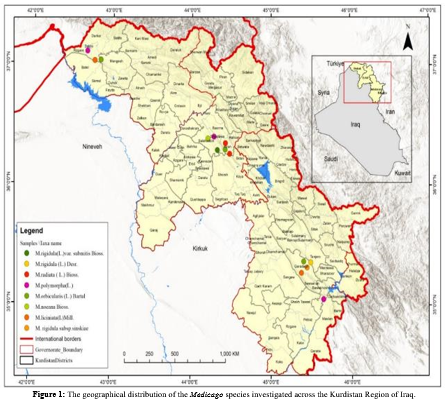
This study provides a thorough morphological analysis of Medicago L. species in Iraq's Kurdistan Region, with the aim of discriminating taxa using a range of vegetative and reproductive traits. Variations in petiole size, leaflet morphology, floral attributes, and pod characteristics were highlighted in morphological examinations of the collected specimens. All the characteristics that were looked at showed distinct interspecific differences. Medicago polymorpha's petiole length ranged from 3.8–5.3 mm, while M. rigidula's ranged from 19–39 mm. with length-to-width ratios of 1.22 for M. radiata and 1.80 for M. noeana, there were notable variation in leaflet proportions, indicating significant shape variation. Peduncle length, in example, differed significantly between M. radiata and M. noeana, measuring 3–8 mm and 10–30 mm, respectively. As pod sizes ranged from 2.5–5.5 mm in M. minima to 13–18 mm in M. radiata, pod shape proved highly diagnostic. Additionally, species identification was made easier by variations in coil number (5–7 coils in M. minima). The identification of M. rigidula subsp. sinskiae as a new distributional record for the Kurdistan Region of Iraq is a significant result of our research. Note that the taxon formerly known as M. sinskiae now has a recognized scientific designation, M. rigidula subsp. sinskiae. All things considered, the observed morphological variety highlights the genus Medicago's ecological difference and offers crucial baseline information for further taxonomic, ecological, and conservation research.
Full text article
References
Al-Atawneh, N. A., Cocks, P. S., & Amri, A. (2009). The distribution and ecology of annual Medicago species in Jordan. Genetic Resources and Crop Evolution, 56(1), 1–13. https://doi.org/10.1007/s10722-008-9336-3
Al-dabbagh, S. T., & Fathulla, C. N. (2022). A Phenetic Study of the Native Species of the Family Fabaceae Lindl. in Iraq. Zanco Journal of Pure and Applied Sciences, 34(2), 43-52. http://dx.doi.org/10.21271/zjpas.
Araújo, D., Forest, F., & de Queiroz, L. P. (2015). Phylogeny of tribe Dalbergieae (Leguminosae: Papilionoideae) and its implications for Dalbergia systematics. Systematic Botany, 40(4), 1133–1147. https://doi.org/10.1600/036364415x690124
Bounjemate, M., Baya, B., & Drousiotis, A. (1992). Variation for salt tolerance in annual Medicago species. Journal of Agronomy and Crop Science, 169(3), 193–200. https://doi.org/10.1111/j.1439-037X.1992.tb00969.x
De Varennes, A., Le Rudulier, D., & Lecomte, P. (2001). Tolerance of Medicago sativa to aluminium toxicity: Role of organic acids. Journal of Experimental Botany, 52(359), 1649–1658. https://doi.org/10.1093/jexbot/52.359.1649
Ehrman, T. A. M., & Cocks, P. S. (1990). Ecogeography of annual Medicago species in Syria. Journal of Applied Ecology, 27(2), 578–592. https://doi.org/10.2307/2404303.
Heyn, C. C. (1963). The annual species of Medicago. The Hebrew University.
Jones, C. A., Maestre, B., & Maraux, F. (2007). Legume-based systems for sustainable agriculture in tropical areas. Tropical Agriculture, 84(3/4), 169–183.
Izadpanah, M., & Jafari, A. A. (2013). Evaluation of Seeds and Pods Variation of 5 Annual Medic Medicago Spp. Journal of Rangeland Science, 3(1), 71-82.
Legume Phylogeny Working Group (LPWG). (2017). A new subfamily classification of the Leguminosae based on a taxonomically comprehensive phylogeny. Taxon, 66(1), 44–77. https://doi.org/10.12705/661.3
Mandal, S., Mondal, C., Bera, A. K., & Mitra, G. C. (2008). Biological nitrogen fixation in legumes and its importance in agriculture. Journal of Soil and Water Conservation, 7(2), 92–97.
Maxted, N., & Bennett, S. J. (Eds.). (2001). Plant genetic resources of legumes in the Mediterranean. Kluwer Academic Publishers. https://doi.org/10.1007/978-94-017-2342-9
Piano, E., & Francis, C. (1992). Salt tolerance in Medicago scutellata and other annual Medicago species at germination and seedling stage. Journal of Agronomy and Crop Science, 169(5), 329–336. https://doi.org/10.1111/j.1439-037x.1992.tb00989.x
Piano, E., Crosti, R., & Cocks, P. S. (1991). The distribution of annual Medicago species in Sardinia in relation to soil and climate. Australian Journal of Agricultural Research, 42(7), 1335–1349. https://doi.org/10.1071/AR9911335
Prosperi, J. M., Le Gall, F., Genier, C., & Jenczewski, E. (2001). Genetic resources of Medicago truncatula: An insight into the genetic diversity of a model legume. New Phytologist, 150(1), 163–172. https://doi.org/10.1046/j.1469-8137.2001.00075.x
Rahman, A. H. M. M., & Parvin, M. I. A. (2014). Study of medicinal uses on Fabaceae family at Rajshahi, Bangladesh. Research in Plant Sciences, 2(1), 6-8. DOI:10.12691/plant-2-1-2.
Skinner, R. H., Keyser, H. H., & Sledge, M. (1999). Genetic variation for dinitrogen fixation in alfalfa. In Alfalfa genetics, breeding, and management. American Society of Agronomy.
Small, E. (2011a). Alfalfa and relatives: Evolution and classification of Medicago. NRC Research Press (now Canadian Science Publishing). https://doi.org/10.1139/9780660199795
Small, E. (2011b). Medicago. In Flora of North America Editorial Committee (Eds.), Flora of North America north of Mexico, Vol. 11: Magnoliophyta: Fabaceae, part 1. Oxford University Press.
Steele, C. L., Renne, N., & Small, E. (2010). The Medicago sativa complex (Fabaceae): A phylogenetic analysis of nuclear ribosomal ITS DNA sequences. Plant Systematics and Evolution, 287(3-4), 183–196. https://doi.org/10.1007/s00606-010-0317-y
Townsend, C. C., & Guest, E. (Eds.). (1974). Flora of Iraq, Volume 3: Leguminales. Ministry of Agriculture and Agrarian Reform of the Republic of Iraq.
Wojciechowski, M. F., Lavin, M., & Sanderson, M. J. (2004). A phylogeny of legumes (Leguminosae) based on analysis of the plastid matK gene resolves deep phylogenetic relationships and indicates partial paraphyly of the Mimosoideae. American Journal of Botany, 91(11), 1846–1862. https://doi.org/10.3732/ajb.91.11.1846
Zareei, R., Small, E., Assadi, M., & Mehregan, I. (2020). The Taxonomic Status of Medicago Sinskiae: Insights from Morphological and Molecular Data. Taxonomy & Biosystematics, 12(44).
Doi: 10.22108/tbj.2020.125443.1132.
Authors
Copyright (c) 2026 Kazheen Jomaa Abdulrazaq, Shamiran Salih Abdulrahman and Jotyar Jassim Muhammed

This work is licensed under a Creative Commons Attribution-NonCommercial-ShareAlike 4.0 International License.
Authors who publish with this journal agree to the following terms:
- Authors retain copyright and grant the journal right of first publication with the work simultaneously licensed under a Creative Commons Attribution License [CC BY-NC-SA 4.0] that allows others to share the work with an acknowledgment of the work's authorship and initial publication in this journal.
- Authors are able to enter into separate, additional contractual arrangements for the non-exclusive distribution of the journal's published version of the work, with an acknowledgment of its initial publication in this journal.
- Authors are permitted and encouraged to post their work online.