
Studying of Some Characteristics and parameters of Argon Glow discharge plasma Using Hollow Anode Diameter

Article Sidebar
-
hollowanode, argon glow discharge, double probes, plasma parameters, negative glow region, MATLAB program
Abstract
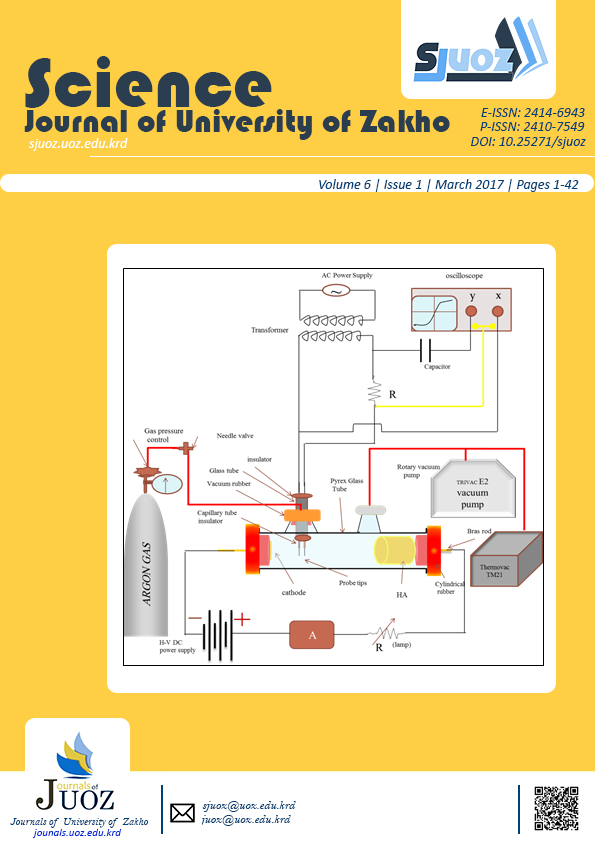
Hollow anode argon glow discharge plasma has been investigated experimentally at different argon gas pressure from constant discharge current. A sufficient high voltage has been applied among the electrodes to obtain breakdown. Firstly, we studied the influence of hollow anode diameter on the breakdown voltage and Paschens law. The inner diameters of hollow anodes used in our work were (10, 15, 20, 25, 30, 35, and 40) mm. Secondly under the same conditions we extended our study to measure some plasma parameters in the negative glow region using direct current argon glow discharge. The temperature and density of electrons in the negative glow were measured using double probes. From the (Ip-Vp) characteristics of double probes, we obtained plasma parameters by using computer MATLAB program. The results showed that the measured Pashence's curve closes to the well-known theoretical Pashence's law. The breakdown voltage and its minimum value decreased with increasing the hollow anode diameter. The Paschen’s curve became wide and shifted to lower pressure with increasing the diameter. The reduction area of hollow anode caused dens and luminous intensity of plasma to occur in the negative glow region. Increasing the diameter resulted in decreasing the temperature and density of electron.
Full text article
References
Authors
Copyright (c) 2018 Shamo Kh. Al-Hakary, Esraa A. Mohammed Saeed, Diyar A. Bleej, Suzan M. Haji, Sahme A. Hussain

This work is licensed under a Creative Commons Attribution 4.0 International License.
Authors who publish with this journal agree to the following terms:
- Authors retain copyright and grant the journal right of first publication with the work simultaneously licensed under a Creative Commons Attribution License [CC BY-NC-SA 4.0] that allows others to share the work with an acknowledgment of the work's authorship and initial publication in this journal.
- Authors are able to enter into separate, additional contractual arrangements for the non-exclusive distribution of the journal's published version of the work, with an acknowledgment of its initial publication in this journal.
- Authors are permitted and encouraged to post their work online.