
EFFECTS OF DIETARY PHYTASE AND ORGANIC ACIDS ON NUTRIENT UTILIZATION AND ANTIOXIDANT STATUS IN Clarias gariepinus

Article Sidebar
-
Clarias gariepinus, Phosphorus Digestibility, Nutrient digestibility, Antioxidant Response
Abstract
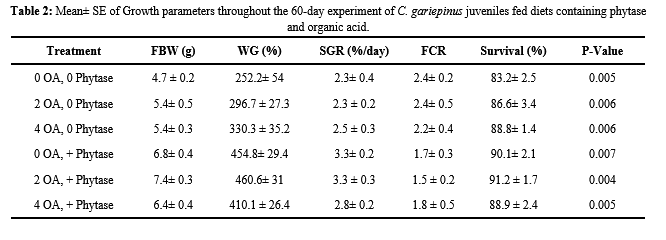
The present study was conducted to examine the effect of phytase and organic acids (OA) on growth parameters such as final body weight(g), weight gain (%) Specific growth rate (%/day), FCR, Survival (%), nutrient digestibility, body composition, and oxidative stress biomarkers in African catfish (Clarias gariepinus). The six dietary treatments for 60 days were designed: control (0% OA, 0 phytase), 2% OA, 4% OA, 0% OA + phytase, 2% OA + phytase, and 4% OA + phytase, each with three replicates. The significant (p < 0.05) results were found on the inclusion of phytase and OA on growth and nutrient utilization. The highest final body weight (7.4 ± 0.3 g), weight gain (460.6 ± 31%), specific growth rate (3.3 ± 0.3%/day), and the lowest feed conversion ratio (1.5 ± 0.2) were found in the 2% OA + phytase group. Apparent digestibility coefficients for dry matter, protein, and phosphorus were maximized at 46.7 ± 1.3%, 77.2 ± 1.4%, and 48.0 ± 1.4%, respectively (p = 0.007), while fecal phosphorus significantly decreased (0.8 ± 0.04 g/kg). Vertebral phosphorus and calcium contents were enhanced significantly (p < 0.05) in the combined supplement group. Oxidative stress markers revealed lower ROS (66.5 ± 1.8), SOD (144 ± 2.6 U/mL), and MDA (5.25 ± 0.14 nmol/mg) levels in the 2% OA + phytase group, indicating enhanced antioxidant defense (p = 0.005). These outcomes indicate that 2 OA inclusion with phytase improves growth, nutrient digestibility, mineral retention, and antioxidant balance in C. gariepinus
Full text article
References
Adeshina, I., Akpoilih, B. U., Udom, B. F., Adeniyi, O. V., & Abdel-Tawwab, M. (2023). Interactive effects of dietary phosphorus and microbial phytase on growth performance, intestinal morphometry, and welfare of Nile tilapia (Oreochromis niloticus) fed on low-fishmeal diets. Aquaculture, 563, 738995. DOI: 10.1016/j.aquaculture.2022.738995.
Afzal, S., Abdul Manap, A. S., Attiq, A., Albokhadaim, I., Kandeel, M., & Alhojaily, S. M. (2023). From imbalance to impairment: the central role of reactive oxygen species in oxidative stress-induced disorders and therapeutic exploration. Frontiers in pharmacology, 14, 1269581. DOI: 10.3389/fphar.2023.1269581
Ahmed, B. S. (2023). Nutritional effects of dietary spirulina (Arthrospora platensis) on morphological performance, hematological profile, biochemical parameters of common carp (Cyprinus carpio L.). Egyptian Journal of Veterinary Sciences, 54(3), 515-524. DOI: 10.3389/ejvs.2023.1276981
Aluta, U. P., Aderolu, A. Z., Lawal, M. O., & Olutola, A. A. (2021). Inclusion effect of onion peel powder in the diet of African catfish, Clarias gariepinus: Growth, blood chemistry, hepatic antioxidant enzymes activities and SOD mRNA responses. Scientific African, 12, e00780. DOI: 10.1016/j.sciaf. 2021.e00780
Antache, A., Simionov, I. A., Petrea, Ș. M., Nica, A., Georgescu, P. L., Oprică, L., & Poroch, V. (2025). Insect–Antioxidants Symbiotic Nexus—Pathway for Sustainable and Resilient Aquaculture: A Case Study for Evaluating Koi Carp Growth and Oxidative Stress Status. Antioxidants, 14(4), 371. DOI: 10.3390/antiox14040371
Bello, A., Dersjant-Li, Y., van Eerden, E., Kwakernaak, C., & Marchal, L. (2022). Supplementation of an all-plant-based inorganic phosphate-free diet with a novel phytase maintained tibia ash and performance in broilers under a commercial production setting. Journal of Applied Poultry Research, 31(2), 100253. DOI: 10.1016/j.japr.2022.100253
Besson, M., Komen, H., Aubin, J., De Boer, I. J. M., Poelman, M., Quillet, E., & Van Arendonk, J. A. M. (2014). Economic values of growth and feed efficiency for fish farming in recirculating aquaculture system with density and nitrogen output limitations: a case study with African catfish (Clarias gariepinus). Journal of animal science, 92(12), 5394-5405. DOI: 10.2527/jas.2014-8266
Bianucci, E., Furlan, A. L., Llugany, M., Poschenrieder, C., & Tolrà, R. (2025). Insights into the physiological and biochemical responses of peanut plants under combined arsenic and flooding stress. Plant Physiology and Biochemistry, 110266. DOI: 10.1016/j.plaphy.2025.110266
Chen, X., Ma, T., Xie, F., & Tang, Z. (2025). Phosphate source apportionment across the agriculture-urban gradient in Asia's longest river: Combining machine learning and multi-isotope techniques. Agricultural Water Management, 320, 109874. DOI: 10.1016/j.agwat.2025.109874
de Sire, A., Marotta, N., Marinaro, C., Curci, C., Invernizzi, M., & Ammendolia, A. (2021). Role of physical exercise and nutraceuticals in modulating molecular pathways of osteoarthritis. International journal of molecular sciences, 22(11), 5722. DOI: 10.3390/ijms22115722
Doherty, V. F., Ogunkuade, O. O., & Kanife, U. C. (2010). Biomarkers of oxidative stress and heavy metal levels as indicators of environmental pollution in some selected fishes in Lagos, Nigeria. Am Eurasian J Agric Environ Sci, 7(3), 359-365. DOI: 10.1012/j.agwat.2010.105874
Elaigwu, A. M., Auta, J., & Onimisi, H. U. (2024). Effect of Phytase-Supplemented Diets on Growth Indices, Nutrient Digestibility and Utilisation, Carcass Composition, and Sustainability of African Catfish (Clarias gariepinus). Aquatic Science and Fish Resources (ASFR), 5(1), 111-121. DOI: 10.21608/asfr.2024.312521.1066
El-Dakar, A. Y., Shalaby, S. M., Mohamed, B. K., & Abdel-Aziz, M. F. A. (2022). Improving the growth, feed efficiency and hematological indicators of Nile tilapia fingerlings Oreochromis niloticus using dietary lactic acid supplementation with different feeding routines. Mediterranean Aquaculture Journal, 9(1), 25-37. DOI: 10.21608/maj.2022.156031.1012
Fazal, R. M., Fatima, A., Al Sulivany, B. S., Hussain, R., Hassan, A., Shahid, A., & Owais, M. (2025). Enhancing growth performance, antioxidant defense, and immune response in striped catfish (Pangasius hypophthalmus) through dietary supplementation with aloe vera: a sustainable aquaculture approach. Science Journal of University of Zakho, 13(4), 510-518. DOI: 10.25271/sjuoz.2025.13.4.1691
Flieger, J., Flieger, W., Baj, J., & Maciejewski, R. (2021). Antioxidants: Classification, natural sources, activity/capacity measurements, and usefulness for the synthesis of nanoparticles. Materials, 14(15), 4135. DOI: 10.3390/ma14154135
Froehlich, H. E., Montgomery, J. C., Williams, D. R., O'Hara, C., Kuempel, C. D., & Halpern, B. S. (2023). Biological life‐history and farming scenarios of marine aquaculture to help reduce wild marine fishing pressure. Fish and Fisheries, 24(6), 1034-1047. DOI: 10.1111/faf.12767
Gao, F., Zhao, Y., Shi, X., Qiao, D., Pei, C., & Kong, X. (2024). Signalling regulation of reactive oxygen species in fish inflammation. Reviews in Aquaculture, 16(3), 1266-1285. DOI: 10.1111/raq.12815
Grujović, M. Ž., Semedo-Lemsaddek, T., & Marković, K. G. (2025). Application of Probiotics in Foods: A Comprehensive Review of Benefits, Challenges, and Future Perspectives. Foods, 14(17), 3088. DOI: 10.3390/foods14173088
Hussein, E. E., Habiba, M. M., Ashry, A. M., Al-Zayat, A. M., Teiba, I. I., Shehata, A. I., & El Basuini, M. F. (2023). Effects of dietary supplementation with organic acids mixture on growth, feed efficiency, hematobiochemical parameters, immunity, and intestinal microbiota of Gilthead seabream (Sparus aurata) juveniles. Aquaculture Reports, 33, 101846. DOI: 10.1016/j.aqrep.2023.101846
Iqbal, M., Afzal, M., Yaqub, A., Anjum, K. M., & Tayyab, K. (2021). Combined effects of citric acid and phytase supplementation on growth performance, nutrient digestibility and body composition of labeo rohita fingerlings. Aquaculture Studies, 22(1). DOI: 10.4194/AQUAST656
Langi, S., Maulu, S., Hasimuna, O. J., Kaleinasho Kapula, V., & Tjipute, M. (2024). Nutritional requirements and effect of culture conditions on the performance of the African catfish (Clarias gariepinus): a review. Cogent Food & Agriculture, 10(1), 2302642. DOI: 10.1080/23311932.2024.2302642
Liang, Q., Yuan, M., Xu, L., Lio, E., Zhang, F., Mou, H., & Secundo, F. (2022). Application of enzymes as a feed additive in aquaculture. Marine Life Science & Technology, 4(2), 208-221. DOI: 10.1007/s42995-022-00133-8
Libanori, M. C. M., Santos, G. G., Pereira, S. A., Lopes, G. R., Owatari, M. S., Soligo, T. A., & Mouriño, J. L. P. (2021). Dietary supplementation with benzoic organic acid improves the growth performance and survival of Nile tilapia (Oreochromis niloticus) after challenge with Streptococcus agalactiae (Group B). Aquaculture, 545, 737204. DOI: 10.1016/j.aquaculture.2021.737204
McCleary, B. V., Sloane, N., Draga, A., & Lazewska, I. (2013). Measurement of total dietary fiber using
AOAC Method 2009.01 (AACC International Approved Method 32‐45.01): evaluation and updates. Cereal Chemistry, 90(4), 396-414. DOI: 10.1094/CCHEM-01-13-0002-R
Moradi, S., Abdollahi, M. R., Moradi, A., & Jamshidi, L. (2023). Effect of bacterial phytase on growth performance, nutrient utilization, and bone mineralization in broilers fed pelleted diets. Animals, 13(9), 1450. DOI: 10.3390/ani13091450
Naiel, M. A., Negm, S. S., Ghazanfar, S., Shukry, M., & Abdelnour, S. A. (2023). The risk assessment of high‐fat diet in farmed fish and its mitigation approaches: A review. Journal of animal physiology and animal nutrition, 107(3), 948-969. DOI: 10.1111/jpn.13777
Nassar, A. A., Gharib, A. A. E. A., Abdelgalil, S. Y., AbdAllah, H. M., & Elmowalid, G. A. (2024). Immunomodulatory, antioxidant, and growth-promoting activities of dietary fermented Moringa oleifera in Nile tilapia (Oreochromus niloticus) with in-vivo protection against Aeromonas hydrophila. BMC Veterinary Research, 20(1), 231. DOI: 10.1186/s12917-024-04045-7
Nathanailides, C., Kolygas, M., Tsoumani, M., Gouva, E., Mavraganis, T., & Karayanni, H. (2023). Addressing phosphorus waste in open flow freshwater fish farms: Challenges and solutions. Fishes, 8(9), 442. DOI: 10.3390/fishes8090442
Ohkawa, H., Ohishi, N., & Yagi, K. (1979). Assay for lipid peroxides in animal tissues by thiobarbituric acid reaction. Analytical biochemistry, 95(2), 351-358. DOI: 10.1016/0003-2697(79)90738-3
Ondiba, R. N., Ogello, E. O., Kembenya, E., Gichana, Z., & Obiero, K. (2022). Future demand and supply of aquafeed ingredients: Outlines to commercialize non-conventional protein ingredients to enhance aquaculture production for food security in sub-Saharan Africa. Aquatic Ecosystem Health & Management, 25(4), 75-84. DOI: 10.14321/aehm.025.04.75
Owais, m., riaz-ud-din, q. U. R. E. S. H. I., irfan, m., jamil, s., yasin, r., ramzan, s., & fazal, r. M. (2023). Effect of Different Salinity Levels on Growth Performance, Hematological Parameters and Proximate Composition of Cyprinus Carpio. University of Sindh Journal of Animal Sciences (USJAS), 7(04), 52-60. DOI: 10.1065/10488398.2023.2046236
Pragya, Sharma, K. K., Kumar, A., Singh, D., Kumar, V., & Singh, B. (2023). Immobilized phytases: an overview of different strategies, support material, and their applications in improving food and feed nutrition. Critical Reviews in Food Science and Nutrition, 63(22), 5465-5487. DOI: 10.1080/10408398.2022.2047226
Pujol, A., Sanchis, P., Grases, F., & Masmiquel, L. (2023). Phytate intake, health and disease:“let thy food be thy medicine and medicine be thy food”. Antioxidants, 12(1), 146. DOI: 10.3390/antiox12010146
Reda, R. M., El‐Murr, A., Abd Elhakim, Y., & El‐Shahat, W. (2022). Aeromonas veronii detection in Egyptian fish farms with summer tilapia mortality outbreaks and the role of formic acid in limiting its spread. Aquaculture Research, 53(3), 940-956. DOI: 10.1111/are.15676
Rodrigues, E. J. D., Ito, P. I., Ribeiro, L. F. M., de Carvalho, P. L. P. F., Xavier, W. D. S., Guimarães, M. G., .& Barros, M. M. (2022). Phytase supplementation under commercially intensive rearing conditions: impacts on Nile Tilapia growth performance and nutrient digestibility. Animals, 13(1), 136. DOI: 10.3390/ani13010136
Sales, J., & Britz, P. J. (2001). Evaluation of different markers to determine apparent nutrient digestibility coefficients of feed ingredients for South African abalone (Haliotis midae L.). Aquaculture, 202(1-2), 113-129. DOI: 10.1016/S0044-8486(01)00531-2
Selim, S., Abdel-Megeid, N. S., Khalifa, H. K., Fakiha, K. G., Majrashi, K. A., & Hussein, E. (2022). Efficacy of various feed additives on performance, nutrient digestibility, bone quality, blood constituents, and phosphorus absorption and utilization of broiler chickens fed low phosphorus diet. Animals, 12(14), 1742. DOI: 10.3390/ani12141742
Silva, L. I. D., Pereira, M. C., Carvalho, A. M. X. D., Buttrós, V. H., Pasqual, M., & Dória, J. (2023). Phosphorus-solubilizing microorganisms: a key to sustainable agriculture. Agriculture, 13(2), 462. DOI: 10.3390/agriculture13020462
Singh, S., Mondal, D., Thakur, M., Habib, M., Jan, K., Dhar, P., & Bashir, K. (2024). Emerging trends in nutraceutical research: Role of minerals. Functional Foods and Nutraceuticals: Chemistry, Health Benefits and the Way Forward, 81-112. DOI: 10.1016/j.nchbwf.2024.102627
Tabassum, S., Hussain, S. M., Ali, S., Sarker, P. K., & Al-Ghanim, K. A. (2025). Moringa oleifera seed meal as a sustainable fishmeal substitute: Growth and health implications for Cirrhinus mrigala. Aquaculture Reports, 40, 102634. DOI: 10.1016/j.aqrep.2025.102634
Yadav, N. K., Patel, A. B., Kashyap, S., Deepti, M., Savaliya, B. D., Singh, Y. R., & Sahu, A. (2025). Phytase as a functional feed additive in aquaculture: growth promotion, nutrient utilization, and environmental mitigation. Aquaculture International, 33(6), 1-31. DOI: 10.1007/s10499-025-01427-3
Zhang, Q., Walk, C. L., Cowieson, A. J., Stamatopoulos, K., Wu, J. L., & Sorbara, J. O. B. (2024). Efficacy of a novel phytase in response to low and high phytate diets using a short-term digestibility model in broiler chickens at two ages. Animal Feed Science and Technology, 307, 115832. DOI: 10.1016/j.anifeedsci.2024.115832
Authors
Copyright (c) 2026 Asma Batool; Neelam Arshad; Ayesha Shahid, Ali Hassan, Bisma Younas, Kainat Shabbir

This work is licensed under a Creative Commons Attribution 4.0 International License.
Authors who publish with this journal agree to the following terms:
- Authors retain copyright and grant the journal right of first publication with the work simultaneously licensed under a Creative Commons Attribution License [CC BY-NC-SA 4.0] that allows others to share the work with an acknowledgment of the work's authorship and initial publication in this journal.
- Authors are able to enter into separate, additional contractual arrangements for the non-exclusive distribution of the journal's published version of the work, with an acknowledgment of its initial publication in this journal.
- Authors are permitted and encouraged to post their work online.