
COAGULATION-FLOCCULATION POTENTIAL OF Achatina achatina SHELL IN THE REMOVAL OF SUSPENDED SOLIDS FROM PAINT EFFLUENT

Article Sidebar
-
Suspended solids, Paint effluent, Coagulation-flocculation, Achatina achatina Shell, Water Pollutio
Abstract
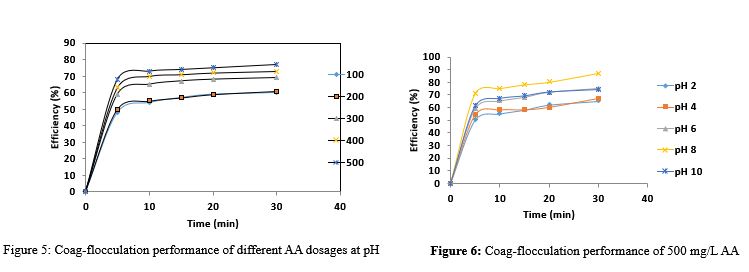
The sewage from paint is quite turbid and contains a lot of suspended and scattered particles. Achatina achatina (AA) shell’s ability to coagulate and flocculate and remove suspended particles from paint effluent was considered. The analyses included Fourier Transform Infrared Spectroscopy (FTIR), Scanning Electron Microscope (SEM) and X-ray Diffraction (XRD). Surface area 64.6 m2/g; ash content 8.2 %; moisture content 11.964 %; bulk density 0.962 g/cm-3; tapped density 1.389 gcm-3; true density 1.667 gcm-3; porosity 42.29 %; pH 7.9; and pHzpc 6.9 are the results of the samples’ delineation. Optimum values obtained from varying the operating parameters are: 500mg/L AA, settling time 30 minutes and pH 8. FTIR result indicates that AA has some functional groups. XRD result indicates that AA consists of aragonite, and SEM shows different surface morphologies before and after coag-flocculation, suggesting effective coagulation. Suspended fragments in the paint effluent sample consistently declined with time, pursuant to time evolution of cluster size allotment. Coagulation period (τ1/2) lowest values of 0.05565 seconds and 0.01209 seconds were recorded at 500 mg/L and pH of 8 respectively. This study provided information on animal based coag-flocculation potential which is beneficial for environmental quality management and environmental disputation.
Full text article
References
Ardila, J., Bijker, W., Tolpekin, V., & Stein, A. (2012). Gaussian localized active contours for multitemporal analysis of urban tree crowns. Paper presented at the 2012 IEEE International Geoscience and Remote Sensing Symposium. DOI: 10.1109/IGARSS.2011.6049856
Adekanmi A. A., Adekanmi U. T., Adekanmi A. S., Ahmad L. K. and Emmanuel O. O. (2023) Production and characterization of chitosan from chitin of snail shells by sequential modification process, Afric. J. Biotechnol., 22(2), 39-53, https://doi.org/10.5897/AJB2020.17135.
Adetoro E. A., and Ojoawo S. O. (2020) Optimization study of biosorption of toxic metals from mining wastewater using Azadirachta indica bark adsorbents, Wat. Sci. Technol., 82(5), 887–904, https://doi.org/10.2166/wst.2020.394
Al Dujaili A. H., and Awwad A. M. (2012) Biosorption of cadmium (II) onto loquat leaves (Eriobotrya japonica) and their ash from aqueous solution, equilibrium kinetics, and thermodynamic studies, Internat. J. Industr. Chem., 3(22), 1-7, https://doi.org/10.1186/2228-5547-3-22
APHA/AWWA/WEF (2017) Standard methods for the examination of water and wastewater, 23rd edn. American Public Health Association, American Water Works Association, Water Environment Federation, Denver, p 874.
Appiah-brempong M., Michelle H., Essandoh K., Asiedu N. Y., Dadzie S. K., and Momade F. Y. (2023) Performance optimization of chemical and green coagulants in tannery wastewater treatment: A response surface methodology approach, J. Optimiza., 19, https://doi.org/10.1155/2023/9939499
ASTM D629-15 (2015) American Society for Testing and Materials, ASTM International, West Conshohocken, PA.
Badawi A. K., Ismail B., Baaloudj O., and Abdalla K. Z. (2022) Advanced wastewater treatment process using algal photo-bioreactor associated with dissolved air flotation system: A pilot-scale demonstration, J. Wat. Proc. Engin., 46, 102565, https://doi.org/10.1016/j.jwpe.2022.102565
Badawi A. K., Salama R. S., and Mostafa M. M. (2023) Natural-based coagulants/flocculants as sustainable market-valued products for industrial wastewater treatment: A review of recent development, Roy. Soc. Chem. Advan., 13, 19335-19355, https://doi.org/10.1039/d3ra01999crsc.li/rsc-advances
Baruah B. K., and Das B. (2021) Assessment of soil fertility status for sustainable productivity: A study in some tea garden belts of Assam, India. Curr. Perspect. Chem. Sci., 6, 128-141, https://dx.doi.org/10.9734/bpi/cpcs/v6
Chen G., Gallegos M. J., Soetrisno D. D., Vekilov P. G., and Conrad, J. C. (2024) A minimal colloid model of solution crystallization nucleates crystals classically, Soft. Matt., 20(11), 2575-2583, https://doi.org/10.1039/D35M01609A
Diagboya P. N., Heyde B. J., and Düring R. A. (2023) Efficient decontamination of aqueous glyphosate using Santa Barbara Amorphous-15 (SBA-15) and graphene oxide-SBA-15 poly-amidoamine functionalized composites, Chemic. Engineer. J., 143263, https://doi.org/10.1016/j.cej.2023.143263
Ekop I. E., Simontan K. J., and Onwuka U. N. (2021) Comparative analysis of physical properties of two varieties of periwinkle relevant to the design of processing equipment, Res. Agricultur. Engineer., 67, 45–50, https://doi.org/10.17221/58/2020-RAE
Elemike E. E., Onwudiwe D. C., Ekennia A. C., Ehiri R. C., and Nnaji N. J. (2017) Phytosynthesis of Silver Nanoparticles using Aqueous Leaf Extracts of Lippia Citriodora: Antimicrobial, Larvicidal and Photocatalytic Evaluations, Mater. Sci. Engineer., 75, 980–989, https://doi.org/10.1016/j.msec.2017.02.161
El mouhri G., Merzouki M., Kachkoul R., Belhassan H., Miyah Y., Amakdouf H., Elmountassir R., and Lahrichi A. (2021) Fixed-bed adsorption of tannery wastewater pollutants using bottom ash: an optimized process, Surfac. Interfac., 22, https://doi.org/10.1016/j.surfin.2020.100868
El Mouhri G., Elmansouri I., Amakdouf H., Belhassan H., Kachkoul R., El oumari F. E., Merzouki M. and Lahrichi A. (2024) Evaluating the effectiveness of coagulation–flocculation treatment on a wastewater from the moroccan leather tanning industry: An ecological approach, Heliyon, 10, e27056, https://doi.org/10.1016/j.heliyon.2024.e27056
Iloamaeke I. M., Nnaji N. J., Okpala E. C., Eboatu A. N., and Onuegbu T. U. (2021) Mercenaria mercenaria shell: Coagulation-flocculation studies on colour removal by response surface methodology and nephlometric kinetics of an industrial effluent. Journal of Environmental Chemical Engineering, 9(4). htps://doi.org/10.1016/j.jece.2021.105715
Irfan M., Butt T., Imtiaz N., Abbas N., Khan R. A., and Shafique A. (2017) The removal of COD, TSS and colour of black liquor by coagulation–flocculation process at optimized pH, settling and dosing rate, Arab. J. Chem., 10(S2), S2307-S2318, https://doi.org/10.1016/j.arabjc.2013.08.007
Irshad M. A., Ali B., Irfan A., Al-Hussain S. A., Nawaz R., Nasim I., Latif M., and Zaki M. E. A. (2023) Sustainable and safe treatment of wastewater of paint industry using Azadarachta indica leaf extract combined with silver nitrate solution, Sustainability, 15, 3592, https://doi.org/10.3390/su15043592
Jiahao A., Nguyen T. N., Yaxuan D., Hao C. (2022). Chestnut shell-activated carbon mixed with pyrolytic snail shells for methylene blue adsorption, Materials. 15, 8227, https://doi.org/10.3390/ma15228227
Kumar A., Singh E., Khapre A., Bordoloi N., Kumar S. (2020) Sorption of volatile organic compounds on non-activated biochar, Bioresourc. Technol., 297, 122469, https://doi.org/10.1016/j.biortech.2019.122469
Mao S., Xu X., Zhang L., Bai B., Hu N. Wang H. (2021) Methylated mud snail protein as a bio-flocculant for high turbidity wastewater treatment, Wat. Sci. Technol., 84(3), 737, https://doi.org/10.1016/j.biortech.2019.122469
Menkiti M. C., Ezemagu M., Okolo B. (2016a) Perikinetics and sludge study for the decontamination of petroleum produced water using Novel Mucuna Seed Extract, Petrol. Sci., 13, 328–339, https://doi.org/10.1007/s12182-016-0082-9
Miyah Y., Lahrichi A., Kachkoul R., El Mouhri G., Idrissi M., Iaich S., Zerrouq F. (2020) Multi-parametric filtration effect of the dyes mixture removal with the low cost materials, Arab. J. Bas. Appl. Sci., 27, 248–258, https://doi.org/10.1080/25765299.2020.1776008
Mustereț C. P., Morosanu I., Ciobanu R., Plavan O., Gherghel A., Al-Refai M., Roman I., Teodosiu C. (2021) Assessment of coagulation–flocculation process efficiency for the natural organic matter removal in drinking water treatment, Wat. (Switzerland)., 13, https://doi.org/10.3390/w13213073
Nair S., Manu B., Azhoni A. (2021) Sustainable treatment of paint industry wastewater: Current techniques and challenges, J. Environ. Managt.,296, 113105, https://doi.org/10.1016/j.jenvman.2021.113105
Nguyen T. H. N., Vo D. L., Toyohisa F. (2023) A critical review of snail shell material modification for applications in wastewater treatment, Mater. (Basel)., 16(3), 1095, https://doi.org/10.3390%2Fma16031095
Nhung N. T. H., Long V. D., Fujita T. (2023) A critical review of snail shell material modification for applications in wastewater treatment, Mater. (Basel, Switzerland)., 16(3), 1095, https://doi.org/10.3390/ma16031095
Nnaji N. J., Okafor N. I., Ekwonu A. M., Osuji O. U., Okwukogu O. O., Okoye O., Anozie A. I., Anene S. C., Ehiri R. C., Onuegbu T. U. (2021) Cashew nut testa tannin resin – preparation, characterization and adsorption studies, J. Taibah. Uni. Sci., 15:1, 170-183, https://doi.org/10.1080/16583655.2021.1930717
Nnaji N. J., Sonde C. U., Nwaji O. L., Ezeh G. C., Onuigbo A. U., Ojukwu A. M., Mbah P. C., Adewumi A. O., Unoka E. C., Otedo J. O., and Onuegbu T. U. (2023) Dacryodes edulis leaf derived biochar for methylene blue biosorption . Journal of Environmenal Chemical Engineering, 11(3). https://doi.org/10.1016/j.jece.2023.1096
Nwajei B. A., Jacob J. N., and Okuo J. M. (2024) Comparative studies on the use of activated snail (Achanita fulica) and perewinkle shells (Typanotonous fuscatu) in the removal of heavy metal ions from aqueous solutions. Ife. J. Sci., 25(3), 331-343, https://dx.doi.org/10.4314/ijs.v25i3.1
Obi C. (2017) Application of Coagulation and Electro-coagulation in Abattoir Wastewater Treatment, M.Sc Thesis, Nnamdi Azikiwe University, Awka, Nigeria.
Oktaf R., Anggi S., Yatim R. W., Syahdilla A. A. R., Ajis P., and Aang H. (2023) Characteristic physicochemical of bamboo-based activated carbon for coal run-off water treatment used at Pt.bukit Asam sludge settlement pond, Internat. J. Soc. Sci., 3(1), 91–96, https://doi.org/10.53625/ijss.v3i1.6380
Oladoja N. A., Raji I. O., Olaseni S. E. and Onimisi T. D. (2011) In-situ hybridization of waste dyes into growing particles of calcium derivatives synthesized from a gastropod shell (Achatina achatina), Chemi. Engineer. J., 171, 941– 950, https://doi.org/10.1016/J.CEJ.2011.04.044
Osabohien E., Overah L. C., Anikwushe Y. U. and Eguvbe P. M. (2024) Comparative Pb(II) Adsorption by Activated Carbon from African Star Apple (Chrysophylum albidum) and Pawpaw (Carica papaya) Seeds, Nig. J. Sci. Environ., 22(1), 161–179, https://doi.org/10.61448/njse2212413
Roy K., Dey T. K., Zuha S. T., Jamal M., Srivastava M., and Uddin M. E. (2023) Removal of turbidity from tannery wastewater using graphene oxide-ferric oxide nanocomposites as an adsorbent, Int. J. Environ. Sci. Technol., 20, 5597–5608, https://doi.org/10.1007/s13762-022-04301-w
Samsami S., Mohamadi M., Sarrafzadeh M. H., Rene E. R., and Firoozbahr M. (2020) Recent advances in the treatment of dye-containing wastewater from textile industries: Overview and perspectives, Proc. Safet. Environ. Protect., 143, 138–163, doi:10.1016/j.psep.2020.05.034
Sun H., Jiao R., Xu H., An G., and Wang D. (2019) The influence of particle size and concentration combined with pH on coagulation mechanisms, J. Environ. Sci., 82, 39–46, https://doi.org/10.1016/j.jes.2019.02.021
Sun Y., Zhou S., Sun W., Zhu S. and Zheng H. (2020) Flocculation activity and evaluation of chitosan-based flocculant CMCTS-g-P(AM-CA) for heavy metal removal, Separa. Purific. Technol., 241, 116737, https://doi.org/10.1016/j.seppur.2020.116737
Viktoryová N., Szarka A., and Hrouzková S. (2022) Recent developments and emerging trends in paint industry wastewater treatment methods, Appl. Sci.,12, 10678, https://doi.org/10.3390/app122010678
Authors
Copyright (c) 2026 Edith C. Unoka , Peter M. Eguvbe, Augustine C. Ogonegbu, Jude O. Otedo, Joel Okpoghono , Uduenevwo F. Evuen, Ochuko J. Abeokut, Augustine Uwague, and Anthony A. Ogbuta

This work is licensed under a Creative Commons Attribution-NonCommercial-ShareAlike 4.0 International License.
Authors who publish with this journal agree to the following terms:
- Authors retain copyright and grant the journal right of first publication with the work simultaneously licensed under a Creative Commons Attribution License [CC BY-NC-SA 4.0] that allows others to share the work with an acknowledgment of the work's authorship and initial publication in this journal.
- Authors are able to enter into separate, additional contractual arrangements for the non-exclusive distribution of the journal's published version of the work, with an acknowledgment of its initial publication in this journal.
- Authors are permitted and encouraged to post their work online.